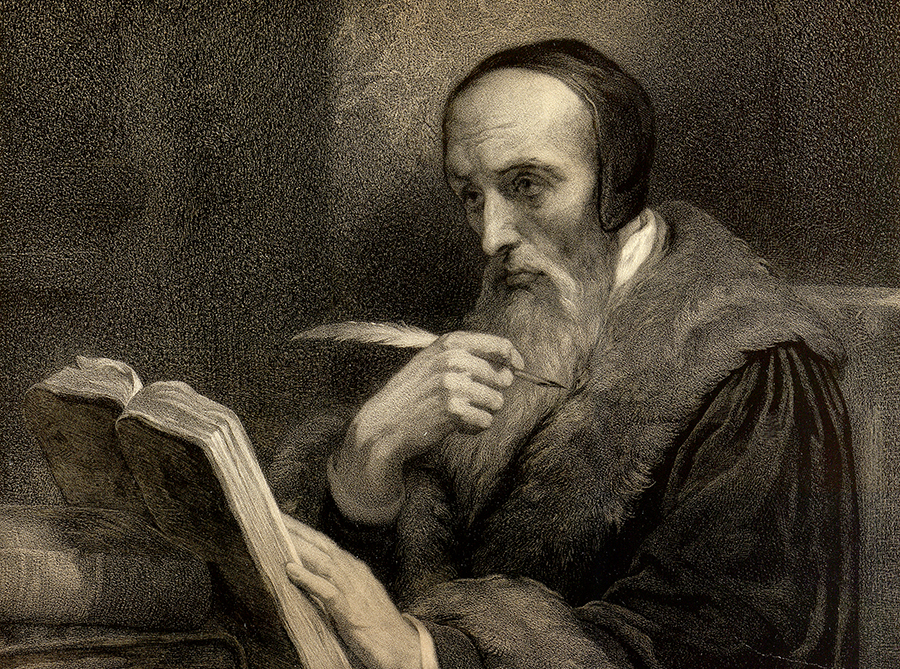
Some notes on Calvinism:
God’s sovereignty and human choice are not a zero sum game. The way Scripture presents reality, human choices are genuinely free, but also foreordained by God. This is known in philosophy as compatibilism – the view that freedom and foreordination are compatible. Theologically, it is known as Augustinianism or Calvinism. A quick illustration might help. In C. S. Lewis’ The Lion, the Witch, and the Wardrobe, why does Edmund betray the others by going to the white witch? We could answer that in at least a couple ways. We could answer in terms of Edmund’s desires and choices – that is to say, Edmund’s free will. He was greedy for Turkish delight, felt left out, etc. and so he freely chose to betray the others. Or we could answer in terms of the storyteller’s plan and purposes: C. S. Lewis decreed and purposed for Edmund to become a betrayer as part of his narrative of redemption. Of course, Lewis is not guilty of Edmund’s betrayal even though he authored it. And because Lewis is “sovereign” over the story, he can turn Edmund’s act of treachery for the ultimate good of Narnia. See how that works? Reality is layered. At one level, Edmund acted according to his own free will. And yet his free choices were also part of the author’s plan and purpose. That’s compatibilism! Of course, this is exactly how the Bible describes the crucifixion (and other events in history) – in Acts 2:23, Peter blames the men for what they did in murdering Jesus, thus holding them accountable for their freely chosen, sin while ALSO insisting that God “authored,” foreordained, and planned all of it.
The Westminster Confession of Faith has a highly nuanced, finely textured section on God’s absolute sovereignty (chapter 3) AND a section on human free will, rightly defined and understood (chapter 9). Note the way the Confession describes the operation of what has been called “irresistible grace” in the chapter on effectual calling. This is how God works in us to save his people: “by his Word and Spirit, out of that state of sin and death, in which they are by nature, to grace and salvation, by Jesus Christ; enlightening their minds spiritually and savingly to understand the things of God, taking away their heart of stone, and giving unto them a heart of flesh; renewing their wills, and, by his almighty power, determining them to that which is good, and effectually drawing them to Jesus Christ: yet so, as they come most freely, being made willing by his grace.” I love that final phrase: we come to Christ freely, but we are made willing to come to Christ by his grace.
There is no question Scripture teaches the absolute sovereignty of God. Nothing comes to pass apart from his decree. He works all things together according to the counsel of his will. Everything that unfolds in history was decreed (planned) by God from before the creation of the world. Nothing can stop, alter, or thwart this divine plan. Even the fall and all subsequent evil in human history is included in the script God has written for history. He uses sin sinlessly to accomplish his wise and righteous purposes. To be sure, we can talk about God’s will in more than one way. We can speak of God’s will as his plan, as I am doing here. Or we can speak of his will as his revealed commands, e.g., it is God’s will that we never sin. Both these senses of the divine will appear in Scripture but there is no contradiction.
We also need to be clear what we mean by “free will” when we are talking about humans. If we mean moral freedom, the freedom to do what is right, Adam had that freedom, but lost it when he sinned. All of humanity, by nature, has been in bondage to sin since Genesis 3. We are not morally free; we are slaves to sin apart from redeeming grace. If by free will, we mean freedom from the plan and decree of God, then man has never had freedom. We are dependent creatures, not autonomous beings. We are all characters in God’s story, not self-existent beings with ontological autonomy. But if by free will, we simply man that man makes choices, and that man always chooses according to his strongest desire at any given moment, then that is certainly true.
If we reject God’s sovereignty because of simplistic slogans like “love would never interfere with free will,” we end up putting almost everything that happens beyond God’s control. Think about it: If you pray that God would keep you safe when you drive somewhere, how God can do that if the free wills of all those other drivers are completely outside his control? He has no more control over your safety than you do because he has no more control over the other drivers than you do. The fact that we pray for God to do things that would require him to be sovereign over human action is proof that we often do better theology on our knees than at our desks.
A sermon on divine sovereignty: https://trinity-pres.net/audio/sermon17-09-24PrayerOfPraise.mp3
“I chose to be a Calvinist. I’m not sure why God predestined some people to be Arminians.”
 TPC Pastor's Page