In C. S. Lewis’ Last Battle, Queen Lucy says, “In our world too, a stable once had something inside it that was bigger than our whole world.” Christmas is about the Creator becoming a creature in order to redeem his creatures. It’s about the God of Israel becoming the perfect Israelite to fulfill Israel’s mission to be a light to the nations. It’s about David’s Lord becoming David’s Son, a king who rules in perfect wisdom and righteousness forever. It’s about the Son of God becoming the son of Mary, the seed of the woman who will slay the dragon, our ancient foe. It’s about Adam’s Maker becoming a new Adam, doing what the first Adam should have done but failed to do.
—
Herman Bavinck saw Mary as the model of femininity and the ultimate proof that the Christian faith honors women:
“When the Son of God deemed a virgin worthy of being his mother, when he has been carried under the heart of a woman, when he has been nursed by a woman, there can be no more talk of contempt for women in Christianity.”
—
T.F. Torrance on the virgin birth:
“The virgin birth is crucial to our grasp of the nature and status in Christ’s eyes of the unborn child. Think of the importance of the incarnation then for our understanding of and regard for the unborn child. Every child in the womb has been brothered by the Lord Jesus. In becoming a human being for us, he also became an embryo for the sake of all embryos. And for our Christian understanding of the being, nature, and status in God’s eyes of the unborn child.”
—
Martin Chemnitz on the virgin birth:
“The Son of God united to himself personally, an individual human body in the very moment of his conception and made it his own. Thus, the Son of God, in assuming his own flesh, though without sin, also endured those things which commonly befall man in conception, pregnancy, and birth. So that from his very beginning, he might first restore in himself our depraved nature and so cleanse and sanctify our contaminated conception and birth, that we might know that Christ’s salvation applies even to man’s fetus in conception, gestation, and birth.”
—
Every time God does something new for his people there is a burst of song.
God creates Eve and Adam sings.
The Israelites escaped through the Red Sea and Moses sings.
Barak and Jael defeat Sisera and Deborah sings.
David gets delivered again and again and he sings each time.
But the burst of songs surrounding the birth of Jesus is unprecedented.
Mary sings.
Zacharias sings.
The angels sing.
Simeon sings.
And we should sing as well.
Merry Christmas!
—
Secular theocracy, Islamic theocracy, or Christian theocracy — those are our choices.
—
This Wilson post is a good summary of the conservative “civil war” – he’s right that abortion, sodomy, marriage, etc. are core issues. You can’t conserve Western civilization while undermining the sexual ethic that built it. Tucker is wrong some things, perhaps, but he is getting the big E on the eye chart correct, while others who supposedly champion conservative causes are badly compromised on the most critical aspects of what we should be conserving. We do need a “conservatism with borders” but we have had open borders on too many core issues.
My one caveat is Islam. While it’s true that, as Tucker says, we are not excperiencing Muslims killing our people in the streets, we are getting robbed of billions of dollars by fraud, largely perpetuated by Muslim immigrants. There is a reason why traditional Western civilization saw Islam as incompatible with any form of Christendom.
—
There is no such thing as casual sex or consequenceless sex.
—
Our society has become a gynocentric “longhouse” because weak and effeminate men have allowed it to become such.
—
In the Collars and Calluses podcast, Bill Smith and I have talked about the masculine “burden of performance.” We got a question about how to square this with salvation by grace. My response:
Everything is of grace and by grace and from grace. In the gospel, Christ bears the burden of performance for his bride, the church. That’s the heart of the gospel. The is not only Christ’s work for outside of us; it includes the Holy Spirit’s work upon us inside of us.
But the gospel does not free us from all obligation or responsibility. Christ’s work for does not negate the requirement that we do work.
When Christian husbands fulfill their responsibilities as husbands, they are doing so by faith, through grace – Christ provides the pattern for husbands. But there really are responsibilities and we must bear them. Husbands have been given commands to protect and provide and they need to fulfill those obligations. The “burden of performance” is just a way of getting at what it means to be a man, a husband, a father. The husband has responsibilities that his wife does not have. As her head, he is responsible for the household in ways that she is not. He has to lead her and his family. He has to manage his household wisely. There is nothing godly or gracious or “gospel-centered” about shirking the load God has placed upon us. Instead, we ask for grace to do what God has commanded.
That’s why we call men to strengthen themselves in the Lord, the way David did in 1 Samuel 30:6. We are calling men to rely on God’s strengthening and empowering grace so that we can do what he has called us to do. Anything else is an effeminate flight from responsibility.
This is really not any different in structure from other duties God gives all Christians in his Word. We are called to walk in good works, by grace through faith. One of the major problems in the church today is antinomian teaching and preaching that treats all duties as a form legalism.
I hope that helps.
—
Sharia is a demonic counterfeit of theonomy.
—
“I’ve never made someone else happy.
The happiness button is on the inside and inaccessible to someone on the outside.”
— C. R. Wiley
—
In American history, the worst features of the civil rights movement (see Christopher Caldwell) and identity politics have gone hand in hand. Identity politics is currently framed in terms of civil rights law — something white identitarians should consider.
—
A lot of men delay marriage because of finances. This is understandable but only to a point. You don’t have to have everything figured out before you marry. If you’re going to be broke either way, it’s better to be broke and married than broke and single (there are a 1000 country songs about this!). Nothing makes men more productive than having a family to shelter and feed. Men need the burden of performance.
—
The window in which Trump can fix things is rapidly closing. Young men and young women continue to diverge, with young men more eager to start families than young women. Some black pilled thoughts from October ’25:
—
“Almost everything will start working again if you unplug it for a few minutes… including you.”
– Anne Lamott
—
A note on Jewish conspiracy theories/anti-Semitism:
If the Jews run the whole world, how did they go 1800 years without a homeland?
—
The Achilles’ heel of evangelicalism has been emphasizing decisions over discipleship – a one time private decision for Christ replaced a lifetime of public discipleship under Christ.
—
It’s remarkable how fast the script flipped from “stop having babies because overpopulation is a big problem” to “we have to open the borders and let an unlimited number of immigrants in because no one is having babies.”
—
According to Junius Brutus, in his Defense of Liberty Against Tyranny, marks of a tyrant include:
Redistributing wealth from worthy to unworthy people
Disarming the people
Promoting gambling, brothels, and other immoral entertainments that effeminize and bastardize the people
Denying men their legal rights
Manufacturing conspiracies against himself to justify an increase in power
Using special interest groups to destroy the common good
—
Romans 13 describes the ideal state: the civil magistrate acts (self-consciously) as a servant of God, punishing evil and rewarding good, according to God’s law.
Revelation 13 describes the Satanic state, that disregards God and makes its power into an idol.
This is what the Christian nationalism debate is about: do you want a Christian state or a Satanic state?
—
“Emotional blackmail happens when a person equates his or her emotional pain with another person’s failure to love. They aren’t the same. A person may love well and the beloved still feel hurt, and use the hurt to blackmail the lover into admitting guilt he or she does not have. Emotional blackmail says, “If I feel hurt by you, you are guilty.”
There is no defense. The hurt person has become God. His emotion has become judge and jury. Truth does not matter. All that matters is the sovereign suffering of the
aggrieved. It is above question. This emotional device is a great evil. I have seen it often in my three decades of ministry and I am eager to defend people who are being wrongly indicted by it.”
— John Piper
—
“Justice being taken away, then, what are kingdoms but great robberies? For what are robberies themselves, but little kingdoms? The band itself is made up of men; it is ruled by the authority of a prince, it is knit together by the pact of the confederacy; the booty is divided by the law agreed on. If, by the admittance of abandoned men, this evil increases to such a degree that it holds places, fixes abodes, takes possession of cities, and subdues peoples, it assumes the more plainly the name of a kingdom, because the reality is now manifestly conferred on it, not by the removal of covetousness, but by the addition of impunity. Indeed, that was an apt and true reply which was given to Alexander the Great by a pirate who had been seized. For when that king had asked the man what he meant by keeping hostile possession of the sea, he answered with bold pride, “What thou meanest by seizing the whole earth; but because I do it with a petty ship, I am called a robber, whilst thou who dost it with a great fleet art styled emperor.”
— Augustine on civil justice
—
From May, 2025, on Stone Choir:/Corey Mahler:
Let me guess….if a German had been in the garden of Eden, he wouldn’t have eaten the forbidden fruit.
This guy is just making up his own religion.
—
Per Romans 13, civil magistrates are required to see themselves as servants (deacons) of God and to rule accordingly, punishing evil and praising good as God defines them.
A state that does not view its authority as deriving from God is a Satanic state.
—
From January, 2025:
Martin Luther was not anti-Semitic, at least not in the way that term is usually understood. He was anti-false religion. He had scathing things to say about the Jews because he opposed their religious faith, just as he had scathing things to say about the Turks because he opposed their Muslim faith. (Note that in the case of Muslims, Luther identified adherents of a false faith with an ethnic category. He did something similar with the Jews of his day.)
Martin Luther did not operate with modern racial categories at all. He was not a racist in any proper sense of the term. His opposition to the Jews stemmed from their theology and resultant practices, not their genetics or physical lineage. He saw the Jewish religion (Judaism) as a false religion and, because Jews rarely converted in his day, a threat to the Christian society in which he lived.
Luther said many terrible things about the Jews that he should not have said. Some of what he said should be done to Jews was likely hyperbole, and would make even the staunchest theonomist blush (eg, he wanted synagogues burned as an application of Deuteronomy 13), but such rhetoric was not uncommon in Luther’s day. Lutherans in recent generations have rightly condemned much of what Luther said and distanced themselves from it. But it’s important to understand that for Luther, the issue was religion, not race. He should be read along the lines of an old covenant prophet attacking a people who have fallen into idolatry rather than a modern racist bigot who targets people because of physical features.
In his final sermon, Luther said this about the Jewish people: “We want to treat them with Christian love and to pray for them, so that they might become converted and would receive the Lord.” This not the attitude of a man opposing a people because of their racial heritage; rather, it is the view of a man opposing a false religion, hoping they will convert to true Christian faith. The very fact that Luther would long for the conversion of the Jews, or even hold it out as a possibility, must be the lens through which we view all his anti-Jewish writings. To put it another way, Luther’s view of the Jews in his day was more like Jeremiah (pronouncing a curse on unrepentant Jews) than Hitler (hating Jews because he sees them as an irredeemable cancer on humanity).
ADDENDUM: Some of Luther’s calls for wanton violence were reckless and even the most ardent theonomist would have a problem with them as an application of the law. Luther was not infallible. But he was also not what has often been supposed.
ADDENDUM: Biblically, I’d have to disagree that ethnicity and religion cannot be separated as a generalization.
Old covenant Israel allowed Gentiles in if they wanted to worship YHWH, and sometimes the Israelites served gods of other nations.
The Great Commission obviously assumes all ethnicities can become Christianized.
Many of Paul’s letters are addressed to multiracial and multiethnic churches.
Etc.
It might be easy to think of Christian faith as “white man’s religion,” but all white peoples were once pagans who worshipped rocks and sacrificed babies.
—
There’s an old saying, “Every woman deserves at least 10 years of widowhood.”
That could be taken a couple different ways.
—
Jesus forgives sins. Jesus changes lives. Jesus rules nations.
—
The Groyper Gaze is as real as the Progressive Gaze.
—
“Conservatism post-Trump will be distinguishable from Trumpism but also from conservatism pre-Trump. It will not be—in the unlikely event that it ever was—anti-Left for the sake of being anti-Left, but because it regards leftist ideas as grave mistakes and serious dangers. So disposed, it will have much more in common with the Trumpist rejection of Democratic Socialism than with Democratic Socialism’s case against Trumpism. The urgency of resisting a Democratic Party whose moderates are increasingly beguiled or intimidated by its radicals also means that the post-Trump conservative movement will neither seek respectability by proudly embracing its own ineffectuality, nor value comity with activists and intellectuals whose aspirations would inflict irreparable harm on the United States.”
— William Vogeli (https://claremontreviewofbooks.com/never-trump-after-2024/)
—
“I am fond of pigs. Dogs look up to us. Cats look down on us. Pigs treat us as equals”
– Winston Churchill
—
“Men are expected to deal with the dangerous stuff of life.”
— Nick Freitas
—
Leftists/progressives hate the Bible and have no real intention of obeying it, but they love to quote select verses (out of context, of course), and weaponize them against conservative Christian positions.
The stupidity of “Mary, Joseph, and Jesus were illegal immgrants” trope is a common example, especially this time of year. Robert Gagnon smashes that here: https://x.com/robertajgagnon1/status/2005506777287209265?s=46&t=au-C34qTtl4rGPFr5igkAw
—
How long until people start saying AI is “unfair” because it is projected to take away more jobs from women than men?
Oh wait, it’s already happening:
—
While there is a war on masculinity/manhood and a war on femininity/womanhood, the war on women is particularly intense and nefarious. Why? Because women bear children and are thus the key to the next generation. Progressives hate children, indeed, they hate humanity; therefore they want to collapse birth rates. Deceiving children women into thinking career rather than family will bring fulfillment is one way to do that. Getting women to think that marriage and motherhood are oppressive is another. Getting women to think of all men as monsters is yet another. All of these are happening right now, and have been for quite some time.
—
When I was a kid, my grandfather used to sayhis favorite lights at Christmas were the taillights on the cars taking the grandkids back home.
He was kidding. At least, I think he was kidding.
—
Some men think the godly or humble thing to do is tolerate their wife’s disrespect. Just put up with it rather than confront it.
This is wrong. And it makes the problem worse.
—
“For unto us a Child is born, Unto us a Son is given; And the government will be upon His shoulder. And His name will be called Wonderful, Counselor, Mighty God, Everlasting Father, Prince of Peace. Of the increase of His government and peace There will be no end, Upon the throne of David and over His kingdom, To order it and establish it with judgment and justice From that time forward, even forever. The zeal of the Lord of hosts will perform this.” (Isaiah 9:6-7)
Note what Isaiah says: The child God gives to his people will be a king and his government will increase. You cannot celebrate Christmas without celebrating Christian nationalism – the truth that all nations belong to Jesus and his rule over them will become progressively more visible over the course of history. Christmas and Christian nationalism go hand in hand.
Christmas has always been political. It’s about the birth of a king. Herod certainly understood that; indeed, he understood what Christmas meant more than many Christians today. That’s why he tried to destroy Jesus right after his birth. Liberals know that saying “Merry Christmas” makes a political statement. And that’s why we Christians need to keep saying it even though liberals don’t like it.
—
“In Christ two natures met to be your cure.”
— George Herbert
—
Augustine in the incarnation:
“Do not follow the current of the flesh. For this flesh is indeed a current; for it has none abiding. As it were from a kind of secret fount of nature men are born, they live, they die; or whence they come, or whither they go, we know not. It is a hidden water, till it issue from its source; it flows on, and is seen in its course; and again it is hidden in the sea. Let us despise this stream–flowing on, running, disappearing—let us despise it. “All flesh is grass, and all the glory of flesh is as the flower of grass. The grass withers, the flower falls away.” Would you endure? “But the word of the Lord endures forever.” [1 Peter 1:24-25]
But in order to succour us, “The Word was made Flesh, and dwelt among us.” What is, “The Word was made Flesh?” The gold became grass. It became grass for to be burned; the grass was burned, but the gold remained; in the grass It perishes not, yea, It changed the grass. How did It change it? It raised it up, quickened it, lifted it up to heaven, and placed it at the right Hand of the Father. But that it might be said, And the Word was made Flesh, and dwelt among us, let us recollect awhile what went before. He came unto His Own, and His Own received Him not. But as many as received Him, to them gave He power to become the sons of God. To become, for they were not; but He was Himself in the beginning. He gave them then power to become the sons of God, to them that believe in His Name; who were born not of blood, nor of the will of the flesh, nor of the will of man, but of God. Lo, born they are, in whatever age of the flesh they may be; ye see infants; see and rejoice. Lo, they are born; but they are born of God. Their mother’s womb is the water of baptism…
But how, one will say, can it be, that the Word of God, by whom the world is governed, by whom all things both were, and are created, should contract Himself into the womb of a Virgin; should abandon the world, and leave the Angels, and be shut up in one woman’s womb? Thou skillest not to conceive of things divine. The Word of God (I am speaking to you, O man, I am speaking to you of the omnipotence of the Word of God) could surely do all, seeing that the Word of God is omnipotent, at once remain with the Father, and come to us; at once in the flesh come forth to us, and lay concealed in Him. For He would not the less have been, if He had not been born of flesh. He was before His own flesh; He created His own mother. He chose her in whom He should be conceived, He created her of whom He should be created. Why do you marvel? It is God of whom I am speaking to you: The Word was God.”
—
Mother Teresa once told women if they want to change the world, “go home and love your family.”
John MacArthur famously told Beth Moore to “go home.”
“Go home.”
If Mother Teresa and John MacArthur are in agreement, you know it has to be right. Add in the Apostle Paul (older should teach younger women to be “workers at home” per Titus 2) and who are any of us to argue?
As women have left the home for the workforce, families have suffered. Feminism has supplanted femininity. Children do not get the love and attention they need. And, ironically, entering public life has not made women happier. This is the “Paradox of Declining Female Happiness,” based on studies that have shown that as women have made “progress” towards “equality” with men politically and economically, they have gotten less happy rather than more happy.
Women do not find fulfillment in competing with men or replacing men, but in helping their husbands and nurturing their children. Feminism deceived women into thinking they would find fulfillment in masculinizing themselves, but this is rebellion against the Creator.
—
Gen X is the most elusive and mysterious of the living generations. But Gen X is also full of paradoxes.
On the one hand, we were the last generation with a fully analog (normal) childhood. Sure, we had video games, but we were a free range generation. While there was some gender confusion going on, most everyone still knew what a man is and what woman is. Masculinity was not yet under attack; it was generally appreciated. People still went on dates and everyone I knew wanted to grow up, get married, and have a family. Those were normal aspirations. America was brimming with self-confidence and optimism. Patriotism was popular, not scorned. I didn’t know anyone who went to a therapist or took mental health medications. If you had trauma, you just dealt with.
But Gen X was also the first generation to bear the brunt of the sexual revolution as children. Premarital sex was normalized. Divorce was rampant, leading to broken homes and latch key kids who largely raised themselves. Abortion was legalized right in the middle of Gen X’s birth years. So Gen X grew up with a lot pain – and that pain was carried into adulthood. Gen X is tough – not quite like the Greatest Generation or Silent Generation since we didn’t fight a war. But definitely tougher than subsequent generations. But behind the toughness lies a lot of confusion and hurt. Gen X is a transitional generation, a bridge between the old cultural order and the new.
—
Any time the power of government is used to redistribute wealth, there will be massive injustices. We have five main ways wealth is transferred today:
From young to old
From male to female
From white to minority
From citizens to illegal immigrants
From middle class to upper and lower classes (upper class get bailouts, lower classes get welfare benefits)
Do this long enough, to enough people, and a couple things will happen. First, you will kill productivity because why be productive if it’s just going to be taken away and given to someone else? Second, you get revolution, because enough people decide the system no longer works for them. Why not burn the system down when it stacks the deck against you?
—
The virgin birth is proof humanity cannot save itself. It’s proof humanity cannot produce its own savior.
The savior must be one of us in human nature but not one of us in that he is sinless.
Where can a fully human sinless man be found after Genesis 3? The virgin birth is the solution to this dilemma. This is why the virgin birth is a non-negotiable aspect of the gospel.
—
Satan tempts us; God tests us. The same experience can be viewed from two different perspectives. Satan is an arsonist trying to burn you to the ground with hellfire. God is a goldsmith, burning away your dross so the remaining pure gold can be fashioned into a crown. Satan hates you and tempts you as a way to destroy you; God hates the dross and wants to burn it off because he loves you and wants to glorify you.
Or, as Augustine put it: “When you are put into the furnace of affliction, will you come forth as gold or grass?”
—
In today’s world, pastors have a duty to be politically partisan. Not in the sense that pastors endorse a particular party or candidate, but in that pastors take specific stances on political issues and teach their congregations about them.
—
Compact has published a lot of great articles lately. This one is quite good on the JQ:
https://www.compactmag.com/article/the-return-of-the-jewish-question/
Here’s another worth reading:
https://www.compactmag.com/article/why-transatlantic-relations-broke-down/
And don’t miss this one on anti-whiteness:
https://www.compactmag.com/article/the-lost-generation/
—
Job 38:7 says the morning stars sang when the world was created. Most commentators take the stars there to be angels.
When the new world was inaugurated at Jesus’ birth, we find singing stars again, as the angels serenade the shepherds (Luke 2).
Angels are associated with stars in the Bible (and in C. S. Lewis’ fiction). Singing stars are singing angels. My hunch is the shepherds and magi saw the same thing in the sky – a glory cloud of angels/stars, pointing them to Jesus.
—
Christmas = God so loved us that he became one of us
Good Friday = God so loved us that he died as one of us and for us
Easter = God so loved us that he was raised as one us to inaugurate the new creation and give us victory over death
—
At Christmas, the Creator became a creature. The God who made man in his image became an image-bearer. The God of Israel became became an Israelite.
—
What does the incarnation mean?
The one who made Adam became a new Adam. The God of Israel became the perfect Israelite. The one who chose and called Abraham became the son of Abraham. The root of David’s family tree became a branch on that family tree.
—
In the incarnation, God the Son became what he was not, a man, without ceasing to be what he was.
The incarnation is an addition, not a subtraction. The Son lost no divine attributes, but he did gain a human nature.
God took to himself a complete human nature in order to heal our humanity, for “that which is not assumed is not healed.” God experienced human life and death from the inside.
__
“In our world too, a stable once had something inside it that was bigger than our whole world.”
— C.S. Lewis, The Last Battle (Queen Lucy)
—
Christmas, rightly understood, contains the whole gospel. The Son of God came as a king, but in humility. He was wrapped in swaddling cloths, foreshadowing when his body would be wrapped in linen burial cloths after his death. He was laid in a feeding trough, because he came to be sacrificial food for the world. The night of his birth, heaven was torn open and angels surrounded the shepherds with heavenly glory; when he dies, the way into the true Most Holy Place will be torn open and we will have access to glory in the heavenly sanctuary, “with angels and archangels and all the company of heaven.” Herod saw him as a rival king and sought to kill him, but he escaped; later, another Herod would have a hand in putting him to death, but he escaped the grave and now rules over all.
Christmas sets the pattern and trajectory of his entire ministry. Christmas is not the whole gospel by itself, but it foreshadows and prefigures the whole gospel. It is foundational to the rest of the gospel story. It contains the seed of the gospel that germinates in his death and resurrection.
Christmas is the beginning of Jesus’ earthly sojourn, but it is an eschatological event. Christmas – the incarnation – means God has tied his future to our future. Our future is as secure as God’s future. Our future is bound to Jesus and his future. What happens to him happens to humanity in him. Because he died and rose again, we will rise after death as well. Because he lives eternally, we will also. Because he has been exalted, we will be exalted too. Christmas means God has bound himself to humanity forever. Christmas means God is with us and for us. Christmas means God has not left us to ourselves; God has come to fight our battles for us. Christmas means God is one with us forever, because he has become one of us forever.
—
What is the incarnation like?
It’s like an author who writes himself into the story so that he can give it the happy ending no one else could.
It’s like a king who sends out his army to face a dragon that tyrannizes his people. But the soldiers in the army keep getting beaten. And so finally the king steps down from his throne, comes to the battlefield, and through great suffering, ultimately defeats the dragon himself on behalf of his people.
—
Christmas is about the Creator becoming a creature in order to redeem his creatures. It’s about the God of Israel becoming the perfect Israelite to fulfill Israel’s mission to be a light to the nations. It’s about David’s Lord becoming David’s Son, a king who rules in perfect wisdom and righteousness forever. It’s about the Son of God becoming the son of Mary, the seed of the woman who will slay the dragon, our ancient foe. It’s about Adam’s Maker becoming a new Adam, doing what the first Adam should have done but failed to do.
—
“The Word entered her [Mary], and became silent within her; thunder entered her, and His voice was still; the Shepherd of all entered her; He became a Lamb in her.”
— Saint Ephrem
—
“The Son of God became a man to enable men to become sons of God.”
— C. S. Lewis, Mere Christianity
—
Christmas — the incarnation — is the foundation of Paul’s doctrine of union with Christ. Union with Christ means “as the Savior, so the saved.” We are participants in his work and share in the benefits he purchased because we are in him. Our union with Christ is only possible because the Son of God united himself with our nature.
—
“The greatest service I can still render to my fellow men would be that I could make the speakers and writers among them thoroughly ashamed ever again to employ the term ‘social justice.’”
— Friedrich Hayek
—
“That Lord through whom all things were made (Jn 1:3), and who was himself made among all things;…the maker and placer of the sun, made and placed under the sun;…producer of heaven and earth, appearing on earth under heaven; unspeakably wise, wisely speechless as an infant.”
–Augustine, Sermon 187
—
Young men, there are still old school women out there like this. Don’t give up hope.
—
This (AI) woman is right.
https://x.com/vicar1973/status/2003529659632517352?s=46&t=au-C34qTtl4rGPFr5igkAw
—
As a Gen Xer, we grew up with virtually no safety rules – no bike helmets, no car seats, drinking from garden hoses, etc. I don’t even think anyone in my family ever wore a seat belt until I was well into my teenage years, and only then because it was a law. The only safety rule I remember from my childhood was “don’t sit too close to the tv.” I especially heard that when I was playing Chopper Command on my Atari 2600.
Today kids are inundated with safety rules, but everyone is a few inches away from a screen all day long. What gives? Were they lying to us about screens? Or did they conveniently drop the rule when iPhones and laptops became ubiquitous? I realize the new screens are different, but it’s still quite funny to this Gen Xer.
—
From what I’ve seen, the Protestant church doesn’t preach enough sermons on Mary and the virginal conception of Jesus. Here’s my stab at it from a few years back:
—
F. A. Hayek was once asked to leave “a statement for the future generations:”
“Modern civilization which enables us to maintain 4 billion people was made possible by the institution of private property. It is only thanks to this institution that we achieved an extensive order far exceeding anybody’s knowledge. If you destroy that moral basis, which consists in the recognition of private property, we will destroy the sources which nourish present-day mankind, and create a catastrophe of starvation beyond anything mankind has yet experienced.”
—
“If you don’t have accountability, you will become what you hate.”
— Steve Deace
—
America first – but which America? There are two Americas, one conservative and Christian, one progressive and demonic.
—
People who are willing to kill the unborn are not fit to govern the born. Abortion – Molech worship – is always the last gasp of a dying empire. Sodomy is as well. The homosexual turn happens when a civilization is burning out and has no future.
—
Effeminacy in men can never be attractive to a woman. Maybe a woman will “settle” for an effeminate man (perhaps thinking she can control him and that will make her happy), but she will always regret it and wish she had done better.
—
Those poor Boomers (like my parents) who bought houses in the early ’80s….

—
Saying “The Jews made America do it” is no better than saying “The devil made me do it.”
This article is worth reading:
https://www.compactmag.com/article/the-return-of-the-jewish-question/?ref=compact-newsletter
—
“The principles of the Republic of the United States can be traced, through the intervening link of Puritanism, to Calvinism, which, with all its theological rigor, has been the chief educator of manly characters and promoter of constitutional freedom in modern times. The inalienable rights of an American citizen are nothing but the Protestant idea of the general priesthood of believers applied to the civil sphere, or developed into the corresponding idea of the general kingship of free men.”
— Philip Schaff
—
“Trust not a woman when she weeps, for it is her nature to weep when she wants her will.”
— Socrates
—
Our culture is full of both misandry and misogyny. There is a war on men and masculinity; there is a war on women and femininity.
But these wars are being waged in different ways. In fact, they are really the same war, which is really a war against God, sex and sexuality, and creational design.
The war of men is overt. It is a direct attack, branding masculinity as toxic. It leads to effeminate, passive, abdicating men. It leads to weak men who are ashamed of their own masculinity. We have beaten men down so much, many men are no longer really men. They don’t know how to be men.
The war on women is covert. Women have been sold lies, packed as empowerment. Women have been told that to have value, they need to mimic men in career aspirations (sacrificing motherhood and family life on the altar of promotions). Women have been told should be like men in their ambition, disagreeability, competitiveness, and aggressiveness.
The result of this double war is the loss of masculinity in men and the loss of femininity in women. And this is a great loss. It is a violation of God’s creational design. It has made marriages rarer and less happy. It has destroyed family life.
—
One reason the world’s dating market is do screwed up is that men and women both operate with double standards and want contradictory things.
Women want men to be chivalrous, to initiate dates, to pay for everything, propose marriage. But they also want to compete with men in the workplace and have egalitarian marriages. They want men to lead during them the dating phase then take a backseat once married. Women want guaranteed equal pay with men in the economy, but want to be with a man who makes more money when it comes to marriage. Many women have sex any time their boyfriends want than weaponize sex by withholding it after marriage. Too many women want men to play by tbe traditional rules why they play by a new set of rules.
Men want to be able to sleep around then marry a virgin (or a woman with a low “body count,” to use the crass terminology of the day). Many men want authority without responsibility. Many men want respect even when they aren’t bearing any burden of performance or leveling up.
It’s such an incoherent mess, even The Atlantic has taken notice:
https://www.theatlantic.com/ideas/archive/2020/02/if-you-want-marriage-equals-then-date-equals/606568/?utm_campaign=the-atlantic&utm_content=edit-promo&utm_medium=social&utm_source=facebook
—
“Sire, it belongs to the church of God, in the name of which I address you, to suffer blows, not to strike them. At the same time, let it be your pleasure to remember that the church is an anvil that has worn out many a hammer.”
— Theodore Beza
—
A British general in India was determined to put an end to widow burning:
“The burning of widows is your custom; prepare the funeral pile. But my nation has also a custom. When men burn women alive we hang them, and confiscate all their property. My carpenters shall therefore erect gibbets on which to hang all concerned when the widow is consumed. Let us all act according to national customs.”
So much for multiculturalism.
—
Secular humanists mock Christians for the doctrine of the Trinity – we worship one God in three persons.
But those same secular humanists ask us to worship one god in 8 billion persons.
—
An excerpt from an old Advent sermon (12/11/2005):
The world today is a joyless place. It is up to the church to show the world what real joy—truly human joy, incarnational joy—really looks like.
Let me give you an example. Many of you are familiar with the work of G.K. Chesterton, the great theologian and writer and thinker. You can just tell from reading his books that he never wrote a page without a big grin on his face because everything he wrote is so enjoyable. He was a master at unmasking the bankruptcy of non-Christian thinking and living. In his book Heretics, he gives a number of examples of this. One of my favorites is when he takes on Auguste Comte. Comte may not be a name that is familiar to you, but at the time he was a well-known philosopher, known as the father of secular humanism. What is interesting about Comte is that when he turned humanism into a kind of new religion, he said that as Christianity continues to wane and wither, and as secular humanism more and more takes the place of Christianity as our new religion, secularists are going to need a new calendar to replace the Christian calendar, to replace those old Christian festivals and celebrations with new humanistic festivals and celebrations.
Of course, you can imagine Chesterton has a lot of fun with this. The whole chapter is worth reading, but this is one of the things he says: as a philosophy, Comte’s worship of humanity is unsatisfactory. It is unreasonable to attack the doctrine of the Trinity as a piece of bewildering mysticism and then turn around and ask men to worship a being who is ninety million persons (or six billion persons in our day, I guess)—in one God, neither confounding the persons nor dividing the substance. Comte has this rationalistic objection to Christianity: we worship one God who exists in three persons. Well, now you’re asking us to worship one God who exists in ninety million persons. How can that be reasonable? Humanity is one god existing in six billion persons. It just doesn’t work. It doesn’t make any sense.
Chesterton says that while the philosophy is the worst part of Comte’s new religion, the ceremony actually is the most sensible part, for at least Comte sees that men cannot live without ritual or festival. If Comte’s religion is to overtake the world, it would have to be through its calendar, not its philosophy—through its new festivals and saints’ days rather than its ideas.
Chesterton says, with a hint of sarcasm no doubt, that while he cannot imagine the pain of having to actually read through Comte’s philosophical works, he can easily imagine, with the greatest enthusiasm, lighting a bonfire on Darwin Day. He can’t get into the ideas, but he can really get into the rituals. But of course, Chesterton goes on to point out that it doesn’t work, it hasn’t worked, and it never can work. After all, no one ever really feels like celebrating Darwin Day. There can be no rationalist festivals because rationalists have nothing to celebrate. Who wants to hang a stocking in honor of Karl Marx? Who wants to put up lights in honor of Immanuel Kant? Who wants to celebrate Aristotle’s birthday? You just can’t get excited about these things.
Chesterton goes on to say, “Men only get gloriously materialistic over things that are thoroughly spiritualistic.” Take away the Nicene Creed and you do serious wrong to the sellers of sausage. No Nicene Creed, nothing to celebrate. It’s bad business for the sausage seller. Wherever you have faith, there you have hilarity. You have something to celebrate. But if man’s reason is all there is, there is no joy. Men will not be filled with hilarity over abstract principles. Only the creed—the Christian creed, the gospel creed—can produce a life of vigor and feasting.
Nobody reads Marx’s Communist Manifesto or Kant’s Critique of Pure Reason and then decides, “You know what I want to do? I want to go out and buy a bunch of gifts and wrap them up in pretty paper and give them to my friends and family.” There is nothing there worth celebrating. There is nothing there that compels joy. But if you tell people a story—a true story about a promised Savior King born in a cattle manger who emerges from the backwoods of his homeland in Judea, who takes on the corrupt religious and political establishment of his day and who ultimately becomes a hero by slaying the dragon of sin and death through his self-sacrificial love—now that is something that people will stand up and cheer for. That is something people will want to celebrate. And as Chesterton points out, because it is something worth celebrating, it is also something worth dying for. If you won’t even put a wreath on your head for it, you certainly won’t die for it. But if you are willing to celebrate it, it is something you are willing to die for.
The world doesn’t have any stories like that, and so they have to borrow their stories from the church. Why is it that in the last couple of years we have seen such a craze over the Tolkien trilogy, the Lord of the Rings trilogy, and now C.S. Lewis’s Chronicles of Narnia? (You could possibly even put the Harry Potter series in this category as well, though that would be debatable.) Why are these things so popular all of a sudden? It is because the world craves a good story.
But we need to ask: why are people so caught up in these stories that are basically just Christian allegories? (Or maybe they are not so much allegories of the gospel, but we certainly have to say they are shot through with biblical images and archetypes and symbolism, and they cannot be understood apart from the Bible.) Because the truth they are intending to communicate is truth straight out of the Scriptures. I read an article this week about how The Lion, the Witch, and the Wardrobe movie isn’t just for Christians—pagans can enjoy it too. Well, that is nonsense. If they stick to the book in the movie, that is nonsense. Obviously you could say anybody can be entertained by this. But if you are really going to understand it, if you are really going to enter into it, you’ve got to believe the gospel story. The Lion, the Witch, and the Wardrobe—that is our story. It belongs to us. It is a retelling of the gospel story.
Lewis tells us why he wrote it. He wrote it so that by finding the gospel there in Narnia, we might know it better here. That by meeting Aslan in that world, we might meet the true Aslan in our world. That is why he wrote. Apart from that, it doesn’t make any sense. These great stories that Lewis and Tolkien wrote are just the shadows of which the gospel is the reality. Those are the myths, but as they both liked to say, the gospel is myth made fact. That is why Christmas and Epiphany and Easter and Ascension Day are all worthy of the greatest celebrations we can give them. They comprise the true myth. They are fairy tales made over into facts. That is what the gospel is.
The church calendar tells the story. It is a way for us to take hold of the story—or even better, it is a way for the story to take hold of us, to shape and mold us. Think again about Lewis’s story, The Lion, the Witch, and the Wardrobe. What is the situation in that story? It is always winter, never Christmas—or you could say it is always Advent, never Christmas—until Aslan comes. As the snow starts to melt, the White Witch is trying to do all these things to stop Aslan from acting, to reverse this. But as Aslan is on the move, things begin happening. One thing that happens is Father Christmas comes around bearing gifts. In one place he spreads a feast for some small animals in Narnia. When the White Witch comes upon this small feast, the animals gather, and she begins to interrogate them. She asks them a bunch of questions. Then she turns them into stone.
Why did she do that? They weren’t really directly involved in the battle. Why does she care? Why does she interrupt the feast? Why does the enemy care if we celebrate? Why should it matter? The truth is, there is great power in the church’s feasting together. As we celebrate God’s goodness in creation, as we celebrate his graciousness in redemption, there is great power in this. Feasting together bonds us into a community. It strengthens our bonds of fellowship and friendship together. Not only that, but God strengthens us by making us participants in his own joy. We could say the church eats her way to victory. We feast our way to dominion. It may be hard at times to convince the world of Christian doctrine, but at least we can show them who throws a better feast. Who has a story worth celebrating? We do!
We are called to a life of joy—a joy that conquers the world, a joy that overcomes the world. In 1534, Martin Luther received a letter from the young prince Joachim of Anhalt seeking his counsel. It seems that the young prince was suffering with melancholy and what he called “dejection of spirit.” Listen to Luther’s wise—and I would say radical—advice to the prince:
“I should like to encourage your Grace, who are a young man, always to be joyful, to engage in riding and hunting, and to seek the company of others who may be able to rejoice with your Grace in a godly and honorable way. For solitude and inwardness are poisonous and deadly to all people, and especially to a young man. Accordingly, God has commanded us to be joyful in His presence. He does not desire a gloomy sacrifice. No one realizes how much harm it does a young person to avoid pleasure.”
Can you imagine a pastor telling a young man in his congregation today, ‘Son, your problem is you’re just not having enough fun. You’re not seeking after pleasure enough’? Luther here says it is harmful to avoid pleasure. No one realizes how much harm it does a young person to avoid pleasure and to cultivate solitude and sadness. Luther continues:
“Your Grace has Master Nicholas Hausmann and many others near at hand. Be merry with them, for gladness and good cheer when decent and proper are the best medicine for a young person, indeed for all people. I myself, who have spent a good part of my life in sorrow and gloom, now seek and find pleasure wherever I can. Praise God, we now have sufficient understanding of the Word of God to be able to rejoice with a good conscience and to use God’s gifts with thanksgiving, for He created them for this purpose and is pleased when we so use them.”
Now, how is that for an answer to depression? Would you give that counsel to a struggling young men? I think that is pretty good advice. I like Luther’s counsel there.
—
Another excerpt from my 12/11/2005 sermon:
The incarnation—that is, God becoming man—can only be celebrated in an incarnational way. That is, with friends, with family, with feasting and singing, with rejoicing in these kinds of ways. It has got to be an earthy thing because our redemption is an earthy thing. Our redemption comes to us through a flesh-and-blood baby who grew up into a full-grown flesh-and-blood man who hung on a tree made of real wood, who shed real blood, whose corpse got put into a real cave, and who then came forth from that grave on the third day came in a renewed but real physical body. It is all real. It is all physical. It is all earthy. Our redemption takes place through the earthly, through the physical, through created things, through the things that God has made.
An incarnational salvation requires an incarnational celebration. The church instinctively knows this. Think about the customs that we have inherited: Celebrating Christmas with trees and ornaments and eating and drinking and giving gifts and candles and parties and songs and wreaths and lights—the church’s instincts in this have been exactly right. We celebrate in ways that can be seen and heard and felt and tasted — just like the Son of God when he took on flesh.
Many people talk about how we commercialize Christmas. But however you deal with that issue, don’t try to spiritualize Christmas. We are celebrating the incarnation of the Son of God. It cannot be an ethereal thing. The Greeks thought of the body as a prison house for the soul. In Greek philosophy and Greek mythology, the way you become holy, the way you get salvation, is by shunning the body, by escaping physical reality. Salvation is an escape from the material world. But what do we offer as a counter to that in the Gospel? The Gospel of the Incarnation is just the opposite. How could God want you to escape the physical and the bodily when he came to inhabit it? He came to inhabit the physical body in order to redeem us. How could God want us to escape it?…
Understand this: when God says celebrate, when God says spend money, buy wine and strong drink and eat and drink together, do what your heart desire — as he does in Deuteronomy —we dare not disobey that. We dare not disobey that command. There is liberation here.
—
Our discussion of feasting has to start at the beginning in the Garden of Eden. How did God have communion with Adam and Eve in the Garden? He did so through a meal, through the Tree of Life. God said they could eat of every tree in the Garden except for one, which means they were free to eat of the Tree of Life. Adam and Eve had a sacramental meal offered to them in that tree. Further: how would God have eventually given them glorified kingship? When they had proven themselves, when they had proven their obedience and faithfulness, how would God have rewarded them? With yet another meal. He would have promoted them to a higher degree of glory through a meal, through eating the Tree of the Knowledge of Good and Evil. Through eating, God would have given them this glory. (They seized that fruit prematurely, but God would have eventually given it to them at the right time had they proven faithful.)
What did Adam and Eve lose when they sinned? They lost access to the fruit, to the Tree of Life. Death was being cut off from the Tree of Life. They were kicked off the mountain-garden of Eden where that food was offered to them. This is the form or shape that God’s punishment took: they no longer had access to the Tree of Life. If this is what judgment consists in, being barred from the Tree of Life barred, what must redemption consist in? It is being readmitted to God’s fellowship through food. It is being readmitted to God’s table. It is being given God’s food again. That’s what we have in the Eucharist.
—
Jesus got crucified because he ate and drank with the wrong people.
—
If you think voting for Democrats helps poor people, you’re really gullible.
—
Christianity is the only religion whose founder was accused of being a drunkard and a glutton.
It was a false charge, but it makes a point: Feasting is at the heart of the Christian faith.
—
Christmas – that time of year when all Christians become postmillennial without even knowing it.
—
Herod understood the politics of Christmas better than most Christians today. He knew a rival king had been born, and this king’s kingdom would upend the kingdoms of the world. Herod tried to stamp out this new kingdom at its inception and failed. Every other anti-Christ tyrant has failed as well. The story that starts with Herod trying to kill baby Jesus ends with Herod dying rather than Jesus.
It’s true another Herod would get his hands on Jesus later in the gospels, and would play a role in Jesus’s death. But of course, that just fulfilled God’s plan of salvation — bringing life to his people through the death of his Son. So even then, Herod doesn’t get the last word — and he laters dies an ignominious death as Jesus lives on, having escaped the grave. Jesus is King. Christ is Lord.
—
Shopping for Christmas gifts is an ancient tradition, going back to the magi who picked up a few last minute gifts on their way to Judea – gold, frankincense, and myrrh. The so-called commercialization of Christmas shouldn’t bother us much; purchasing and giving gifts have been part of Christmas from the very beginning.
—
If you can’t enjoy, indeed laugh at, the deep creational differences between men and women, something is wrong with you.
Vive la difference!
—
Christmas is the one time of year the world approaches sanity.
People are more joyous, more generous, more grateful. It’s a glimpse of the way the world really ought to be.
—
Christmas means the eternal Word of Life has come to us as one of us. The eternal Word was born of a virgin, wrapped in swaddling cloths, and laid in a manger. Baby Jesus was God in the flesh, the eternal glory of God entering our history and our humanity, in humility, to restore us to fellowship with himself and with one another.
—
Christmas is about God putting skin in the game.
—
The gospel is a love story written in blood – the blood of God.
—
Everyone seems to think young women are doing fine while young men are in crisis. But it’s impossible for one sex to do well while the other fails because the sexes are bound together in a relationship of mutual dependence. We stand or fall together. No one can win the “war of the sexes”; the very fact of such a war means everyone loses. The sexes or win or lose together.
Besides, young women have a crisis of their own. While superficial numbers look good, eg, women are in college and the workforce at higher rates than ever, those things have very little to do with success and happiness for women over the long haul. Consider:
— 40% of young women do not want to marry or aren’t sure, 30% of young women do not want children or aren’t sure
— 25% of young women have had an abortion, 75% believe abortion should be legal with no restriction, and many rate it as their most significant political issue
— 75% of divorces are initiated by women (90% if college educated)
— 1.4 million young women are on Only Fans
— $30,000+ average education loan indebtedness (not to mention many carry additional credit card debt)
— nearly 30% identity as LGBTQ
— nearly 30% are getting mental health treatment
— 67% are politically liberal/progressive
Those are staggering numbers. Our young women, on the whole, are not doing well. But, again, young men are considered the “problem.”
—
As we approach Christmas, it’s important to remember what this season is about.
In a word, Christmas is about Christ. Christmas is about Christology. Christmas is about the Father sending his Son, the Christ, into the world through the work of the Holy Spirit. Jesus Christ is God and man, two complete natures joined in his one person.
The incarnation is central to the Christian gospel. Unless Jesus is fully God and man, he could not accomplish our salvation.
This is why it is so fitting to celebrate Christmas — it is the foundation and fulfillment of our hopes. The wider culture (e.g., Hollywood) has been largely successful in turning Christmas into a humanistic celebration, full of sentimentality. The culture, at best, treats Christmas as a celebration of family or “the human spirit.” We must reject such non-sense. The only reason the world should rejoice this time of year is that (as Isaac Watts’ paraphrase of Psalm 98 puts it), “the Lord has come.”
—
In Luke 2, heaven opened when the angels met the shepherds. Suddenly the shepherds found themselves surrounded by a choir of angels and a revelation of glory. It’s interesting how much this theme of heaven opening shows up in Advent and Christmas hymnody. Examples:
- “O Come O Come Emmanuel” – “Key of David come and open wide our heavenly home”
- “Good Christian Men Rejoice” – “he hath opened heaven’s door” • “While Shepherds Watched Their Flocks” – “good will henceforth from heaven to men, begin and never cease”
- “All Praise to Thee Eternal Lord” – “forlorn and lowly is thy birth, that we may rise from heaven to earth…to make us, in the realms divine, like thine own angels round thee shine”
- “Once in Royal David’s City” – “for that child so dear and gentle is our Lord in heaven above and he leads his children on to the place where he is gone”
- “Thou Who Wast Rich Beyond All Splendor” – “stooping so low but sinners raising, heavenward by thine eternal plan”
What does this mean? Why does heaven open to the shepherds? Why do they see the night sky filled with heavenly glory, a glory that surrounds them? The lowly shepherds are types and representatives of what all God’s people will enjoy in the new covenant. The shepherds are given access to heaven, which is now the privilege of all Christians in union with Christ (Hebrews 4, 10, 12). In Christ, we are priests with access to the shekinah-glory and throne room-sanctuary of heaven.
The revelation of glory to the shepherds is a sign that the shekinah-glory, once hidden away behind the curtains in the most holy place, has come out from behind the curtain to be fully present with his people. This is why Jesus is called “Immanuel,” meaning “God with us.” He is the embodiment and revelation of the divine glory (John 1). All who trust in Jesus know the glory of God.
—
Good summary of what DEI has done:
—
Megan Basham on feminism, female agency, abuse, and consent:
“You cannot both claim that women are men’s equals and should be elevated to positions of greater influence and authority within the church and also claim that they are so uniquely vulnerable that even at age 26 they lack the agency to meaningfully consent to sex.
Both things cannot be true.”
—
An old X post:
I fully believe that globalist multiculturalism (like what is running rampant in the UK today) needs to be stopped.
But I don’t believe that Aristotle is the best weapon to do so.
The reality is that in America today, as in medieval/Christian Europe, descendants of the very people Aristotle said could not get along are getting along quite well.
America is a nation full of descendants from Europe – but in Aristotle’s day Europe was filled with warring tribes that despised and dehumanized one another.
What happened? In a word, the gospel.
The Apostle Paul went through the same region that Aristotle was familiar with and created communities called churches in which those different ethnic groups came together.
The fact that this is invisible to us today is largely proof of the gospel’s astounding success.
The problem with relying on Aristotle is that it commits you to an ontology of strife and violence. For Aristotle, interethnic strife is not the result of the fall. It’s just the way things are. Strife and violence are natural, built into the very fabric of reality. That’s a denial of Christian teaching about creation and eschatology. While Christians believe that there would have been many ethnicities in an unfallen world, we believe they would have been at peace. Of course, we also believe countless ethnic groups will live at peace with one another in the resurrection.
So how do we destroy the multiculturalism we see in our day?
1 We use the gospel. The gospel still transforms and unites people. The gospel is the solution to the world’s problems.
2 We show that nations have no obligation to commit civilizational suicide by allowing unrestricted immigration by people who have no interest in assimilating.
3 We demonstrate that we actually have an obligation to preserve our all that is good about our people, our culture, and our heritage as an application of the 5th commandment.
4 We end the welfare state, which draws immigrants like moths to a flame. Stop giving free stuff away and people will not be as eager to come here.
5 We must state the obvious: the main immigration problem in the West comes from Muslims invading once Christian nations. Islam is a demonic religion and the sworn enemy of Western civilization. There is no way to integrate serious Muslims into the West. It has never worked. Immigration needs to be limited to people who are relatively like-minded (coming from a Christian heritage) and who intend to assimilate.
6 We must remind all Western nations that their civilization was created by the gospel. If we don’t want to sink to the levels of the third world, we must reclaim our Christian heritage.
ADDENDUM: Empires often forced ethnic mixing as a way to weaken loyalties
Deportations to a new place also weakened loyalties
But even within the Roman Empire, many people groups maintained a strong ethnic identity
This was true of Jews, obviously, but many other peoples as well
ADDENDUM: The same strategy used by ancient pagan emperors is being used today by globalist “elites”
There are a few differences of course, but it’s the same basic play
—
“America now suffers from a full-blown identity crisis. If we hope to recover a coherent national identity, we must start with the Bible. Conservatives and Christians who want to revive the American tradition must demand — unapologetically — the return of scripture and prayer to public life.”
Amen x1000!
MAGA is inseparable from MACA. We cannot rebuild our civilization without the tools that created it in the first place, and the most important tool was Scripture.
Great article:
—
From June 2025:
The state of American public education today: A teacher gets fired for reading out loud from an American classic, one of the best and most insightful books one of own has ever written.
—
Flannery O’Connor on American Gnosticism–
“When Emerson decided, in 1832, that he could no longer celebrate the Lord’s Supper unless the bread and wine were removed, an important step in the vaporization of religion in America was taken, and the spirit of that step has continued apace. When the physical fact is separated from the spiritual reality, the dissolution of belief is eventually inevitable.”
—
Stephen Miller:
“The Left has been trying to shove Marxism, Socialism, and Communism down the throats of the American people for generations now … The Democratic Party shifted their tactics to use migration as a weapon to break down the middle class and gain political power and to gain power and control in this country … to destroy social and community cohesion.
And in that rubble, in that chaos, in that conflict, to then try to articulate the need for evermore government control, evermore government redistribution, evermore government power.
And then to ultimately import voters to support that agenda.”
—
Whatever we think might be broken with the American system and the American economy — and no doubt there are many things that need fixing — we should not let our criticisms over shadow the glorious reality that we live in the most prosperous and comfortable nation that has ever existed. Do not let a sense of entitlement drive out gratitude. America has provided the platform on which more prosperity has been built for more people than any other nation in history — no small feat. So yes, make your criticisms and offer your proposed fixes, but also be incredibly grateful for the God-given blessing that comes with being American.
—
Just a reminder: It’s possible to believe the “good guys” won World War II AND believe the post-war consensus is a real problem. It’s also possible to believe the post-war consensus was just an intensification of trends that were already present in Western civilization long before WW2. And, frankly, most of what we think of as the post-war consensus did not really hit the mainstream until after the Cold War, in the 1990s (so maybe we should think of the post-war consensus as the post-Cold War consensus).
cleartruthmedia.com/articles/the-p…
tpcpastorspage.com/2025/03/18/pos…
ADDENDUM: The liberalism that Americans lived under in the 1940s-50s had lots of problems, but was obviously better than living under communism or fascism. We can critique what liberalism has morphed into without positing moral equivalence. Also, note that America had a strong elite/aristocracy in the 1950s and church attendance was high — even higher than it had been before WW2.
Today’s progressive ideals were not what motivated the American soldier. After we won WW2, we won the Cold War as an encore. Yes, we have fallen off a cliff spiritually and culturally, but let’s appreciate what America got right. Again, most of what we call the post-war consensus was not mainstreamed until after the Cold War. American men were the heroes of the 20th century – we won 2 world wars, won the Cold War, put a man on the moon multiple times, and built up the greatest infrastructure and widespread economic prosperity in history.
—
“Action absorbs anxiety.”
— Scott Galloway
—
Don’t chase your dreams. Chase your skill set. Chase opportunity.
Don’t follow your passion. Follow your what you’re good at until it becomes a passion.
—
Life isn’t about what happens to you, it’s about how you respond to it. Your life might not be your fault, but it is your responsibility.
—
Only one man can say, “No one has ever suffered as I have.” Only one man’s suffering is truly unique.
That man is Jesus.
—
Everyone is saying young men have “radicalized.” I suppose that’s true in some cases. A figure like Andrew Tate would have been considered too vile to get a lot of traction 50 years ago, maybe even 30 or 20 years ago.
But the data shows that young men in general really haven’t changed their views all that much over the last generation. It’s the young women who have changed – indeed, it’s the young women who have been “radicalized.” Young women have become far more feminist, far more progressive, far more aggressively pro-abortion and anti-marriage/motherhood, and far less religious over the last generation.
Today’s typical 20 year old male is much more similar to a 20 year old male from 30 years ago than a 20 year old female today is to a 20 year old female from 30 years ago. Men have been pretty stable; women have not been stable.
Young men today are more likely to be conservative, church-going, and traditionalist than young women. And so why do we keep hearing that young men are the problem? That young men have gone “radical”? All the data suggests it’s actually young women who are the outliers, the radicals. Young women have changed much more than young men. We have the narrative exactly backwards – and so all the “solutions” the media gives will only make things worse.
Of course, it’s all progressive, left wing propaganda. They want you to think young men are the “problem” and that they’ve changed in a “radical” way and are now “dangerous.” But, again, the data says the opposite – it’s the young women who have radicalized far more than the young men. If marriage and family are critical to a flourishing civilization, young women pose a much bigger threat than young men. The real issue behind the mainstream narrative is that men have been far more resistant to the progressive agenda. That’s why they’re considered the “problem.” In reality, today’s young men will be the solution (if there’s going to be a solution at all).
That’s not to absolve young men of their particular sins, eg, everyone knows online porn is a problem for young men. But young men are the last line of resistance against full on progressivism. It’s not so much that young men are “radicalizing,” it’s that they’re opting out of a system that despises them. Unless that system invites them back in on their own terms, the future of our civilization is indeed bleak.

ADDENDUM: Even Orwell noticed young women could be very submissive to Big Brother. And today, we see young women voting in extreme numbers for communism/socialism.
—
Young men, when pursuing a wife, never let a woman’s beauty cloud your judgment about her character.
—
It’s a dad’s job to teach his kids about the hard realities of life. It’s a mom’s job to comfort them when they hear about those hard realities.
—
The point of Christian parenting is NOT to get your children to make A decision for Christ. Rather, it’s to get to them to make EVERY decision for Christ.
—
“Pastor, why do you wear a white robe when you lead the worship service on Sundays?”
“Because I am Gandalf the white! No, seriously, it’s because I am acting as an official representative of Jesus and when we see him in the book of Revelation, he is robed in white. I am not leading the service as a private person but as an ambassador of Christ and his kingdom. I am doing the King’s official business so I wear an official uniform.”
—
Charles Spurgeon:
“Religion never was designed to make your pleasures less.”
—
A note on John 13:
“If we do not show love to one another, the world has a right to question whether Christianity is true…
Our relationship with each other is the criterion the world uses to judge whether our message is truthful – Christian community is the final apologetic.”
–Francis Schaeffer
—
A parable on immigration (reposted from January 2025):
This is why the “Ordo Amoris” discussion matters right now:
Imagine kids whose dad has neglected them. Instead of taking care of his own kids, he’s been spending time, energy, and resources on strangers across town. He’s even letting these strangers vote in family meetings! He’s been buying strangers groceries while his own kids are starving. When the house his kids live in got flooded by a hurricane, he couldn’t be bothered to help; he was too busy giving his money away to strangers.
It’s understandable that the kids would get upset with dad and eventually grow resentful.
But then suddenly dad comes back home and says to his own kids, “I’m going to start taking care of you like I should have all along. My love for strangers on the other side of town, at your expense, was a disordered love. I’m going to get my priorities straightened out. I want to make our family great again!” You can see why the kids would be excited and grateful.
The analogy is not perfect because nations are not identical to families. But the point about disordered loves and priorities in our politics has been a crucial issue for a long time now.
—
“Truth always carries with it confrontation. Truth demands confrontation; loving confrontation nevertheless. If our reflex action is always accommodation regardless of the centrality of the truth involved, there is something wrong.”
–Francis Schaeffer
—
Repost from August 2024:
Every book in the New Testament teaches that our eternal destiny hinges on doing good works
There is no salvation without obedience
Good works are necessary if we are to be saved
You will not be forgiven without repentance
Do not be deceived: You will reap what you have sown
—
“There is a sad myth going around today – the myth of neutrality. According to this myth, the secular world gives every point of view an equal chance to be heard. And it works fairly well – unless you are a Christian.”
–Francis Schaeffer
—
Repost from February 2025:
A married couple who had spent most of their lives on the mission field was being interviewed. At one point the interviewer asked the wife, “So when were you called to the mission field?” She replied, “I never had a call to the mission field. I had a call to be my husband’s helper. He had a call to the mission field, so I went along to help him in it.”
There’s a lesson in there.
—
A lot of white people need to repent of their self-loathing.
—
“The devil exulted when Christ died, but by this very death of Christ the devil is vanquished, as if he had swallowed the bait in the mousetrap. He rejoiced in Christ’s death, like a bailiff of death. What he rejoiced in was then his own undoing. The cross of the Lord was the devil’s mousetrap; the bait by which he was caught was the Lord’s death”
— Augustine, on the cross as a “mousetrap” that deceived the devil into bringing about his own demise
—
From November 6, 2024:
The time of situationships, hook ups, and cohabiting is over. The time of unnecessarily delaying getting hitched is over. The time of androgyny is over. It’s time to make marriage great again.
It’s time for men to embrace their masculinity and women to embrace their femininity. The wickedness and folly of the sexual revolution has been exposed. Feminism and widespread fornication are a failed cultural experiment that have caused untold misery and harm. It’s time to get married, stay married, and have lots of kids. It’s time to make family great again.
—
“Above all things, learn at once to worship your Creator and to do His will as revealed in His Holy Book.”
—Robert E. Lee
—
Going from feminism to Fuentes (or Tate) is just going from one ditch to another.
—
It’s amazing and weird that women can become famous for doing things men have already done.
—
The biggest threat posed by AI is not that it will take jobs, but take freedom. An AI surveillance state is a tyrant’s dream.
—
The progressive project of importing Muslims, Hindus, etc. into Western nations is based on the false premises of egalitarianism and pluralism – namely that all religions are equal. But the Christian faith is not the same as Hinduism which is not the same as Islam – or any other religion. Progressivism is based on a lie.
—
Trying to turn men into women never works. Trying to turn men into housewives REALLY never works.
—
The answer to DEI’s anti-whiteness is not white supremacy. It’s not white identity politics as such. It’s not affirmative action for whites.
We simply need to do away with DEI and allow for free association.
—
On colonialism and savages:
James Cook said of Pacific island savages, “They live in a tranquility which is not disturbed by the inequality of condition. The earth and sea of their own accord furnishes them with all things necessary for life. They covet not magnificent houses, household stuff, etc.” Ironically, just a few years later, a group of Pacific savages stole one of his boats and then killed him. Maybe the savages weren’t as tranquil as he thought.
—
Many young women are voting for progressivism today because they treat the state as a substitute for patriarchy. They trust Caesar to protect and provide for them, to give safety and security, more than the men in their lives. But a lot of young men vote for statism as well, because they don’t want to have to take on the patriarchal responsibilities of protecting and providing, but would rather pass those responsibilities off to the state.
—
If young women use the state as a substitute patriarchy, expecting Uncle Sam to be a surrogate husband and father, young men are looking to influencers like Andrew Tate and Nick Fuentes as a substitute patriarchy. None of this ends well. There is no substitute for the real patriarchy that God set up in the beginning.
—
Young men (especially white men) are being oppressed and yet being told they are the oppressors. They are being discriminated against while being told they have privilege. What do you expect them to do?
—
A lot of people are looking into the effect that Nick Fuentes’ rhetoric has on young men right now. That should definitely be investigated. But we should also be looking into the impact Fuentes’ messaging has on young women — even if they don’t listen to him, they will still be impacted by what he says and are likely to hear some of his most crass talking points somewhere along the way. The result will be alienating young women from young men even more than has already happened. Young women will conflate Fuentes’ version of “patriarchy” with the biblical teaching on headship, be understandably repulsed by it, and will further discredit all forms of masculine leadership in their minds. If the future of civilization depends on young people marrying and starting families, Fuentes is part of the problem, not the solution. Whereas Charlie Kirk wanted to bring the sexes together in marriage, Fuentes will have the opposite effect.
—
DEI hypocrisy is real. J. D. Greear in the SBC is a good example of a white male who is anti-white and anti-male but would never step aside and give his position to someone else the way he demands of others:
—
Young women are voting for progressivism mainly because they are treating the state as a substitute for patriarchy. But a lot of young men vote for statism as well, because they don’t want to have to take on patriarchal responsibilities but rather pass those responsibilities off to the state.
—
Racializing everything (as the left has done) is not helpful or healthy. Only a very sick person processes every event and interaction through the lens of race. Only a disturbed person thinks about race all the time. Frankly, the less we have to think about race, the better off we are.
—
“A holy man is a mighty weapon in the hands of God.”
— Robert Murray M’Cheyne
—
It never ceases to amaze me that some people are attracted to hyper-preterism. It’s just such a hopeless position; it leaves the biblical story without any final resolution.
Plus, it creates some real oddities that even the most wild exegetical gymnastics cannot get around.
In light of 1 Corinthians 11:26, why do hyper-preterists continue to celebrate the Lord’s Supper?
In light of Luke 20:34ff, why do they continue to marry?
—
Feminism declares all men guilty and proving innocence is impossible. The cause of the guilt? Simply being male.
Being female = original righteousness
Being male = original sin
—
“The most important single central fact about a free market is that no exchange takes place unless both parties benefit.”
— Milton Friedman
—
Any position can be made tenable, provided brave men are willing to make it so.
—
When conservative evangelicals join the Roman Catholic Church, I always wonder, “Why would you want to join the church of Nancy Pelosi and Joe Biden? Why would you want to put yourself under a communist archbishop (which is what the Pope is these days)?” It just makes no sense.
What I find is that people who make this move end up excusing Rome’s error and magnifying those of the evangelical or Reformed tradition they are leaving. It’s utterly foolish and dishonest. It’s a double standard, unfairly applied.
—
“Courage is contagious. When a brave man takes a stand, the spines of others are often stiffened.”
—Billy Graham
—
It’s time to retire the phrase “sinning in the right direction.” Some sins are greater than others but all sin is sin.
ADDENDUM: It is true some sins are less anti-nature than others. But if nature is shorthand for “God’s creational design,” all sin is against nature and nature’s God. Sodomy is a more aggravated sin than, say, fornication, but both are contrary to the way God made us to live. We can and must distinguish degrees of sin, as the Westminster divines did; we can distinguish high-handed sin from sins of wandering, as the book of Leviticus does; but sin is still sin, and even the smallest sin in and of itself, is worthy of death and hell. Some sins are more anti-natural than others, but all sin is contrary to nature. All sin is moving in the wrong direction.
—
As the world goes insane, one of the best things a pastor can do in his sermon each Sunday is give his people a reality check. Good preaching puts people in touch with the most basic realities there are, namely God, the way God designed creation to work, sin and its just deserts, sin’s solution in the cross of Christ, and the powerful work of the Holy Spirit in our lives through the means of grace.
—
In the West, we are letting evil run rampant. We simply don’t have the will and moral courage to stand up to it anymore:
https://x.com/jonnajarian/status/2000546553224671329?s=46&t=au-C34qTtl4rGPFr5igkAw
The old saying is true: “Tolerance can reach such a level that intelligent people are banned from thinking so as not to offend the imbeciles.”
—
Russell Kirk summarized the foundational pillars of Western civilization:
“Cant and equivocation dismissed, it seems to me that there are three great bodies of principle and conviction that tie together what is called modern civilization.
The first of these is the Christian faith: the theological and moral doctrines which inform us, either side of the Atlantic, of the nature of God and man, the fatherhood of God, the brotherhood of man, human dignity, the rights and duties of human person, the nature of charity, and the meaning of hope and resignation.
The second of these is the corpus of imaginative literature, humane letters, which is the essence of our high culture: humanism, which with the Christian faith, teaches us our powers and our limitations–the work of Plato, Virgil, Cicero, Dante, Shakespeare, and so many others.
The third is a complex of social and political institutions which we may call the reign of law, or ordered liberty: prescription, precedent, impartial justice, private rights, private property, the character of genuine community, the claims of the family and of voluntary association.
However much these three bodies of conviction have been injured by internecine disputes, nihilism, Benthamism, the cult of Rationalism, Marxism, and other modern afflictions, they remain the rocks upon which our civilization is built.”
—
When Pat Buchanan was in high school, he had a reputation for getting into fistfights. I never saw that as a reason to not vote for him when he ran for president in the 90s.
—
“…as also our beloved brother Paul, according to the wisdom given to him, has written to you, as also in all his epistles, speaking in them of these things, in which are some things hard to understand, which untaught and unstable people twist to their own destruction, as they do also the rest of the Scriptures.”
— 2 Peter 3:15-16
Peter says some people take Paul’s words and twist them to their own destruction because they are untaught and unstable. My guess is Galatians 3:28 was one of those Pauline texts Peter had in mind. Many people in the past and today have twisted that text to their own damnation.
—
Nick Fuentes says many things that are true. The problem is that he is one of the “lost boys of the West” so he cannot save those lost boys. He has a sick, perverted, pornographic mind and that vitiates any good he might otherwise offer. Unfortunately, his vileness is corrupting a huge swath of today’s young men.
—
Some say, “pastors should not preach on the culture war.”
But this imposes an extra-biblical standard upon the pastor, who is called to preach the whole Bible. It muzzles the preacher so he cannot say what’s God’s Word says in many areas – and precisely in those areas where the pastors flock needs to be discipled.
If we are not supposed to preach on so-called culture war issues, what is left to preach? There are very few issues in our culture that have not been politicized. There are very few issues that are not connected to the culture war in some way.
If we are not supposed to preach on culture war issues, then marriage and sex cannot be preached because every aspect of marriage and sex have been swept up into the culture war. Obviously it is ridiculous to say these issues should not be taught on from the pulpit. A pastor who does not address marriage and sex is not a faithful pastor. He has to be able to define marriage and male/female. He has to be able to talk about God’s sexual design.
Or take something that might seem to be more distant from the culture wars, but really isn’t, like anxiety. Preaching on anxiety might seem to be insulated from the culture war, but it’s really not. As soon as we start preaching on anxiety, we are going to touch on issues of mental health, medication, and the causes of anxiety. Each one of these will get into culture war issues. We live in a culture that once stigmatized mental illness but now glorifies mental illness; surely the church must say something about that. The issue of medicating away anxiety and other emotional problems has been a hot topic in the culture since the Rolling Stones sang about it in their 1966 song, “Mother’s Little Helper.” If Mick Jagger recognized we were overmedicating women in the 1960s, surely today’s pastor can notice it. What are the causes and curses of the anxiety rippling through our culture? The church has to say something about this topic. There are many reasons for increased anxiety in the culture today, ranging from family breakdown to social media use to incompetent leadership at virtually every level of government and society, and so it is impossible to separate the causes of anxiety from the wider problems facing our world. If we are going to cast our cares on the Lord who cares for us, we have to identify those cares, and that will undoubtedly run us into culture war territory.
Or take another example that may seem far removed from the culture wars but really isn’t: Love of neighbor. It might seem like a pastor could preach on love of neighbor without getting entangled in the culture war. But a few years ago, we have had leading evangelicals and many politicians from both sides of the aisle tell us that loving our neighbor requires shuttering the economy, canceling public worship services, socially distancing, not visiting the sick in hospitals or the elderly in retirement communities, receiving an experimental vaccine, and wearing a mask in public. Either love of neighbor requires these things or it does not, but it is impossible to remain neutral. The church will either meet or not. The church will either require masks or not. There’s no way to avoid these issues. Further, we often told living neighbor means voting a certain way or not criticizing various “lifestyle choices” (we know what that euphemism stands for). Training people in biblical love of neighbor inevitably involves touching on culture war issues.
This is really the bottom line: It is simply impossible for the faithful pastor to avoid the culture war. It is all pervasive. It has seeped into almost everything. There is no way a church’s leadership or a pastor in his preaching can somehow avoid being a combatant in the culture war. The calling of the church is not to somehow transcend the culture war (that would likely turn us into Gnostics) but to fight the culture war faithfully.
—
I used to think the result of the conservative movement cancelling Pat Buchanan was Donald Trump. Now I’d say it’s Nick Fuentes.
Pat Buchanan was a Christian gentleman. Nick Fuentes is….not.
—
The welfare system is a mousetrap. People think the government is providing for them; in reality, it is enslaving them into an economy of dependence.
—
Responsibility and authority always go together.
Responsibility without authority is slavery.
Authority without responsibility is tyranny.
—
Russell Kirk rightly said Christian faith and the gentleman built Western civilization.
—
A great example of the emptiness of empathy.
This woman felt bad for the homeless person but didn’t actually help.
She wouldn’t take the risk of inviting the person into her home – and then complains about a system her vote no doubt helped create.
Nor would she pay out of her own pocket to get the person a hotel. She’s not exactly the Good Samaritan.
Is it risky to help someone? Is it costly to help someone. You bet. That’s just part of it. There is no escaping risks and costs.
—
Brandon Warnke on DEI hypocrisy:
“Tenured white male academics push the costs of their affirmative action policies onto others while making no sacrifices themselves. And then applaud one another for it.
Judith Jarvis Thomson noticed this problem in 1973. She identified the proper solution but was unwilling to defend it: the older, comfortable, tenured white male academic who demands affirmative action should be expected to resign or share his job.”
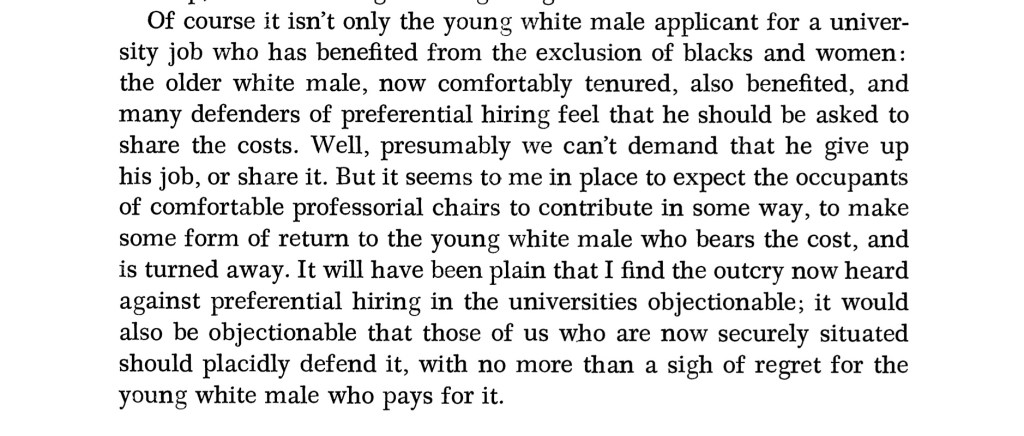
—
“DEI is a euphemism for discriminating against young white men.”
— Whyvert
Good article: https://x.com/matthewschmitz/status/2000556991375409159?s=46&t=au-C34qTtl4rGPFr5igkAw
—
“Christianity should be twisted in with national constitutions, that the kingdoms of the world should become Christ’s kingdoms [Rv [1:15), and their kings the church’s nursing-fathers [Is 49:23]…
What is the principal intention of this commission; to disciple all nations….”Admit them disciples; do your utmost to make the nations Christian nations;” … Christ the Mediator is setting up a kingdom in the world, bring the nations to be his subjects; setting up a school, bring the nations to be his scholars; raising an army for the carrying on of the war against the powers of darkness, enlist the nations of the earth under his banner”
— Matthew Henry
—
“If the church confines its teaching to spiritual matters, it must neglect most of Scripture, which speaks to man’s condition in every area of life. Christian faith is either relevant to all of life or it is relevant to none of it: the claims of God are either total, or He is not God. To ask Christianity to stay in its own territory is to ask it to stay in all of life. Religion as the Bible conceives of it and declares it has no separate domain apart from the rest of life. It is the over-all purpose and meaning of all life in its every sphere. … The task of the church must be to challenge every sphere of life in the name of the sovereign God and the Lord Jesus Christ. The Great Commission requires that all nations be made disciples, and every sphere of life be brought under the dominion of Christ the King, made to hear Christ the Prophet, and find its redemption and intercession in Christ the Priest. Anything less than this is a defamation of the Gospel.“
— Rushdoony
—
“Islam hates us. There’s something there that’s a tremendous hatred. We have to get to the bottom of it…
It’s radical [Islam], but it’s hard to SEPARATE because you don’t know who’s who!…
There’s an unbelievable hatred of US…we have to be very vigilant. We have to be very careful. We can’t allow people to come into this country who have this hatred.”
— Donald Trump
See: https://x.com/ericldaugh/status/2000306559864500501?s=46&t=au-C34qTtl4rGPFr5igkAw
—
The alternative to the culture war is a kinetic war.
—
A thread from September 12, 2024:
In the early 1980s, Francis Schaeffer wrote,
“The basic problem of the Christians in this country in the last eighty years or so, in regard to society and in regard to government, is that they have seen things in bits and pieces instead of totals.”
This problem applies to a lot more than just knowledge about society and government – it applies to virtually every area of learning.
And the problem has only gotten worse. The internet, especially social media, specializes in giving people bits and pieces rather than wholes. In many ways, this has destroyed learning. Who can get a proper, “big picture” education in a social media age? Who can see the “totals” when your primary sources of information can only serve up bite sized pieces by design?
1/3
I’ve seen this impact young men wanting to enter pastoral ministry. Their theological education has come in bits and pieces. They might know a lot about a particular area of interest – like typology or the Christian family – but they do not have a well-rounded knowledge of the Bible or systematic theology. They may know a lot of rather obscure things but cannot answer questions about basic orthodoxy. They may know a good bit of practical information in some area but they have missed the big picture in many ways.
I’ve seen it happen in other areas. A guy picks up a few key pieces of knowledge about Reformational political theology or historic liturgy and thinks he’s an expert. But just following a few X accounts that focus on these areas does not actually give one a deep level of knowledge. You cannot become an expert in anything on this app or any other social media app. All X posts can ever give you is bits and pieces – never any “totals,” as Schaeffer would call them. To get “totals” requires a different kind of study – one that demands far more work, more patience, more effort.
2/3
The worst effect of getting things in bits and pieces rather than totals is that it makes us way overconfident. You don’t know what you don’t know. A social media age makes it easy to think you’re closer to being an expert in some area than you really are. It makes it easy to think you know more than you really do.
I fear far too many people are spending time on social media that would be better spent reading real books. I’m not just talking about time people spend scrolling on mindless entertainments – that’s obviously not helping. No, I’m talking about people who follow more serious accounts and pick up a lot of good info from apps like this one. It’s still important to recognize the severe limitations of what you can absorb in this format, no matter how good the account is. You are only getting bite sized pieces here – at some point you’ve got to get a full meal elsewhere.
3/3
—
Christians, especially some Reformed Christians, reject natural law reasoning of any sort because they fear nature will end up “eating” grace. With secularized or autonomous conceptions of nature, this is a valid fear, as Francis Schaeffer showed. But I actually think the problem in our day is the opposite. Grace – a secularized version of grace – has eaten up nature.
1/2
In post-Obergefell America, Americans now believe they are free to do anything they want (supposedly without guilt and without consequence) because there is no order or law in the creation. There is no law above us by which we will be measured. There is no “nature of things” we have to respect, no hard edges to reality that will cut us if we disregard them, and so any laws imposed on how we use our bodies are considered irrational and oppressive. Our culture’s postmodern version of grace – a lawless grace if there ever was one – has eaten up nature and left everything in flux. If ever there were a time for reasserting Paul’s doctrine of nature in Romans 1:18ff, this is it. In fact, reasserting a Pauline doctrine of nature is necessary to proclaiming a Pauline doctrine of grace.
For more:
pastor.trinity-pres.net/essays/obergef…
2/2
—
Schaeffer and Van Til both blamed Thomistic dualisms (especially reason/faith) for the rise of secularization in the West. It’s actually somewhat similar to what Schmemann does. Whether or not any of them are fair to Thomas (and are possibly conflating later varieties of Thomism with Thomas himself) is another question.
—
“Socialism protesting against production for profit objects to what makes the extended society possible.
Profit is a signal which tells us what we must do in order to serve people whom we don’t know.”
— Hayek
—
“No totalitarian authority nor authoritarian state can tolerate those who have an absolute by which to judge that state and its actions. The Christians had that absolute in God’s revelation. Because the Christians had an absolute, universal standard by which to judge not only personal morals but the state, they were counted as enemies of totalitarian Rome and were thrown to the beasts.”
— Francis A. Schaeffer
—
“At its core…the Reformation was the removing of the humanistic distortions which had entered the church.”
— Francis A. Schaeffer
—
“It is not only Christians who can paint with beauty, nor for that matter only Christians who can love or who have creative stirrings. Even though the image is now contorted, people are made in the image of God. This is who people are, whether or not they know or acknowledge it. God is the great Creator, and part of the unique mannishness of man, as made in Godís image, is creativity. Thus, man as man paints, shows creativity in science and engineering, and so on. Such activity does not require a special impulse from God, and it does not mean that people are not alienated from God and do not need the work of Christ to return to God. It does mean that man as man, in contrast to non-man, is creative.”
— Francis A. Schaeffer
—
“Men, in a word, must necessarily be controlled either by a power within them, or by a power without them; either by the Word of God, or by the strong arm of man, either by the Bible, or by the bayonet.”
— Robert Winthrop
—
“All might be free if they valued freedom, and defended it as they should.”
— Samuel Adams
—
“Neither the wisest constitution nor the wisest laws will secure the liberty and happiness of a people whose manners are universally corrupt.”
— Samuel Adams
—
The Second Amendment is essentially the right to protect your rights.
—
“[T]he advantage of being armed… the Americans possess over the people of almost every other nation….
Notwithstanding the military establishments in the several kingdoms of Europe…the [European] governments are afraid to trust the people with arms.”
— James Madison, Federalist 46, 1788
—
“A free people…ought to be armed.”
— George Washington
—
“Before a standing army can rule, the people must be disarmed; as they are in almost every kingdom in Europe. The supreme power in America cannot enforce unjust laws by the sword; because the whole body of the people are armed, and constitute a force superior to any band of regular troops that can be, on any pretense, raised in the United States. A military force, at the command of Congress, can execute no laws, but such as the people perceive to be just and constitutional; for they will possess the power, and jealousy will instantly inspire the inclination, to resist the execution of a law which appears to them unjust and oppressive.”
— Noah Webster, “An Examination of the Leading Principles of the Federal Constitution” (1787).
—
Posts from August 2024:
Too many Christians, particularly pastors, hoard their wisdom rather than share it.
We need to preach what we practice.
To give an example of the kind of thing I have in mind:
I know a number of men in pastoral ministry who have raised faithful, mature Christian kids. When the children were young, these men’s wives stayed home as mothers, completely devoted to loving, nurturing, disciplining, and teaching their children. That pattern – the husband as sole provider so his wife could be completely given to the work of motherhood – bore great fruit in the life of the family. The kids grew up, stayed in the faith, and became productive members of society.
But these same men would never teach their congregations that mothers should be “workers at home,” focused “loving their husbands and children” (Titus 2:3-5). These pastors might go out of their way to say that the Bible does not require women to be domestic helpers. They do not critique the careerism of so many modern women. They even subtly pushback on what they consider “patriarchy” or traditional sex stereotypes.
In short, they do not preach what they practiced – even though what they practiced bore great fruit. And the result is detrimental to many families in their congregations who are led to think there is no divinely prescribed family order, and a woman choosing to be a “stay at home mom” is just making a quaint lifestyle choice, not in any way preferable to any other choice she might make. These pastors are failing to share their wisdom with others because that wisdom is not politically correct and is controversial.
This is one of the Achilles’ heels of the contemporary evangelical church: a lot of pastors are more traditionalist (and I’d say biblical) outside the pulpit than in it. They live wise and fruitful private lives but they do not publicly teach to others what has worked so well for themselves. They do not apply the Bible to their congregations the way they apply it to their own lives because it would rock the boat.
—
From August 10, 2024, in response to this:
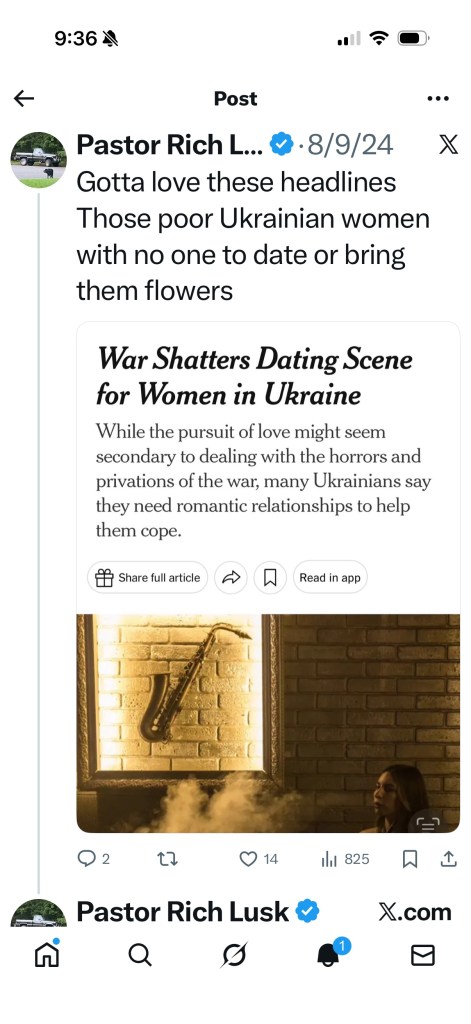
In a recent conference talk on masculinity, I pointed out that our highly gynocentric (woman-centered) society often only notices man’s problems insofar as they create an issue for women — male suffering only registers when it keeps women from getting what they want
The New York Times headline above is the perfect example of this
The headline ignores the fact that men are suffering on the battlefield; instead it highlights that (because the men are away from home to fight a war), women in Ukraine are suffering without anyone to date
The Hilary Clinton quote is the classic example of solipsism and gynocentrism – male suffering is recast as a problem for women, male suffering is an issue only because it sometimes keeps women from living their best life now – the only suffering worth noticing is the suffering of women
This dynamic is one of the most unhelpful aspects of the post-sexual revolution gender wars
Women do not empathize with the plight of men any more
Would any American newspaper have published an article in the 1940s about how the REAL suffering was not the men off fighting Nazis but women who had to spend Fridays nights home alone because the men they wanted to date weren’t around? Of course not! It would have been viewed as petty and ridiculous
The talk I gave can be found here:
trinity-pres.net/audio/24-08-02…
—
Every time God does something new for his people there is a burst of song.
God creates Eve and Adam sings.
The Israelites escaped through the Red Sea and Moses sings.
Barak and Jael defeat Sisera and Deborah sings.
David gets delivered again and again and he sings each time.
But the burst of songs surrounding the birth of Jesus is unprecedented.
Mary sings.
Zacharias sings.
The angels sing.
Simeon sings.
And we should sing as well.
Merry Christmas!
—
Zacharias’ Song, the Benedictus, in Luke 1:68-79 mixes categories that Christians today often try to keep separate, namely the spiritual and the political.
Zacharias is clearly describing a spiritual and personal salvation. He sings about mercy to sinners and the gift of forgiveness. He describes knowing God and worshipping him without fear. He makes it clear God’s salvation makes us holy and righteous.
At the same time, the context and content of the song shows that Zacharias is not privatizing the salvation Jesus will bring. Contextually, Zacharias’ role in Luke’s gospel is bracketed by references to two tyrants – Herod, when we are introduced to Zacharias in 1:5, and Caesar Augustus in 2:1, right after Zacharias’ part in the story is complete. Thus, when Zacharias speaks of the coming Messiah delivering us from our enemies and those who hate us (1:71, 74), it is impossible to spiritualize these enemies away. To be sure, Satan is our ultimate enemy and Jesus does deliver us from him. But we often face Satanic enemies in those who oppose God’s truth and God’s people – again, tyrants like Herod and Augustus. Jesus’ salvation is not merely internal, inward, in our hearts; Jesus came to establish a kingdom, fulfilling the Davidic promises, and setting the world to rights. His salvation transforms everything it touches – and it touches everything. “He came to make his blessings flow far as the curse is found.” Zacharias is singing about a salvation that not only changes hearts, but changes cultures and nations. If it didn’t, it would be a complete rupture with the old covenant prophetic expectation and the promises God had made to his people. Jesus saves sinners; Jesus rules the nations. The gospel includes both dimensions.
Zacharias’ song is filled with exodus themes and language. It’s a new “Song of Moses.” The new exodus, promised by Isaiah and other prophets, is now arriving. Words like “visit” “redeem,” and “remember” are exodus words, rooted in the past, but now elevated to a new plane. But if the old exodus is the pattern for the new, this has implications for how we understand salvation. Think about it: Was the first exodus under Moses a spiritual or political salvation? It was clearly spiritual; it freed Israel from the gods of Egypt, it was based on the blood of the Passover lamb (with its attendant sacramental meal), and it aimed at creating a people who would worship God and enjoy communion with him. At the same time it was obviously a social and political salvation; it freed the people from slavery to a tyrant, and led to the people living under the judicial and civil laws of the Torah, a perfectly just civil code. In the original exodus, the spiritual and social aspects of salvation are mixed together. In the new exodus, they are as well.
Thus, Zacharias was exactly right: Jesus came to bring us forgiveness and the knowledge of God, to create a holy and righteous people who freely worship God without fear. But Jesus also came to overthrow tyrants and transform nations, to make the kingdoms of this world his own kingdom, to rule as a new Davidic king over the kings of earth. Zacharias’ song is both personal and political, demonstrating the complete salvation Jesus brings. This salvation will not be consummated until the last day when he comes again in glory, but it has a transformative effect in history.
—
In the Bible, Old Testament and New Testament, salvation is always the same way. After the fall of man into sin, the only way anyone is saved is by the blood of Christ. Old covenant saints were saved by trusting in the Christ to come. In the new covenant, we are saved by the Christ who has come.
How could God save people by Christ before Christ came? In a sense, they were saved on credit – and that credit came due at the cross, when Jesus paid their debts.
Salvation has always been by grace from beginning to end. New covenant saints do enjoy privileges that old covenant saints did not. They had union with the coming Christ, we have union with the glorified Christ. We have greater revelation (a completed Bible) and better sanctuary access (now that Christ has entered the heavenly throne room, we can as well in prayer and worship). We are promised greater success in our mission; Satan can no longer deceive the nations, and blessings are flowing out to all the families of the earth in a much greater way than before. So the new covenant is new and indeed better. But the way of salvation is always the same – by grace alone, through faith in Christ alone.
—
Christmas – the birth of the Christ – happened because God kept a promise.
God promised to come and dwell with his people, to be with them. In Jesus, that promise is fulfilled. He is “Immanuel,” God with us. In Jesus, God visits his people.
God promised to come and redeem his people. In the coming of Jesus, he makes good on that promise. In Zecharias’ song, the Beneditcus, he speaks of redemption in the past tense even though Jesus is still in Mary’s womb – that’s how certain he was of what Jesus would do. Future events are described in the past tense as if they’ve already happened because the plan is in motion.
God promised to send a king, a son of David, who would rule over the world. In Jesus, that king has come. Of the increase of his government, there will be no end. He sits upon the throne of David and the throne of God. He reigns over the nations with a shepherd’s rod.
God promised through Malachi that the Sun of Righteousness would arise with healing in his wings. God promised through Isaiah a light would dawn on those sitting in darkness. Zecharias sang of a light that would come to guide our feet in the way of peace. In Jesus, that light has come. He is the light of the world, the light that overcomes the darkness and scatters the shadows. Christmas is a season of light because God has kept his Word. That light now shines upon us and through us. The lights of Christmas are a reminder God has banished the darkness of sin and death for all who trust and hope in Jesus.
Again: Christmas is God keeping a promise. Christmas is God remembering his covenant and performing what he promised. Christmas is God showing he is as good as his Word. Christmas is God doing exactly what he said he would do. Christmas is God keeping his covenant.
—
The new covenant is not God scrapping what went before and starting over – it is God finishing what he had already begun.
The Old Testament is a story in search of an ending. That ending is found in Jesus – and what a happy ending it is!
—
The book of Proverbs makes it clear that it’s possible to be surrounded by wisdom and yet still be a fool. The fool in Proverbs heard good teaching; he had access to wise counselors; and yet in his stubborn pride, he refused to absorb the wisdom on offer and remained mired in folly.
—
We are facing an affordability crisis that is driving a bigger and bigger wedge between the haves and have nots. The biggest difference is assets. Those who get ahead do so because they have assets that appreciate in value faster than inflation – mainly real estate and stocks.
—
Zecharias’ song known as the Benedictus in Luke 1:68-79 is basically a transformed version of the Song of Moses in Exodus 15. It presents Jesus as the one who will accomplish a new and greater exodus.
—
From November 2024:
I know a lot of men will think that the first thing to do with a wife who is not following their leadership is to go to the elders about it. I do think a man in that kind of frustrating marital situation should look to other men in the church for counsel and help, including checking out his own life for any failings and then confessing any sin on his part. Other men can hold up a mirror to him.
But I do not think his first resort should be to take his wife to meet with the session (unless she is in some kind of open, flagrant sin). He would be better off finding some older Titus 2-type women in the church who could speak with his wife and perhaps help her along. It’s likely that if a man’s wife is not cooperating with his leadership, another woman would be better starting point for helping her understand what proper submission in marriage is and how to practice it.
I hate to put it this way, but many men get the marriage they deserve. Many men think they are red-pilled because they have a strong concept of headship, but they really have no clue about how to lead a woman with grace and prudence. They think they know what their wives should do in the marriage, but they do not actually understand women. Headship in a marriage is rarely as simple as, “I command, you obey.” It actually takes wisdom to lead a wife and govern a household well. If a Christian man married to a Christian woman leads with competence, confidence, and character, most of the time the woman will naturally find herself admiring, respecting, and following him. Sin will still get in the way (and it is possible for a woman to rebel against a good husband), but women were created to respond to the loving initiative of men, so such a man is going with the grain of his wife’s created nature as he leads her.
—
Our culture’s systemic misandry is one of those problems many people recognize (especially on the right, but even sometimes on the left) and yet no one – literally no one – with power lifts a finger to try to solve it.
Young men continue to be scapegoated, shamed, and emasculated (and as a result often radicalized), yet no one in power throws them a rope. Young men face discrimination and loss of opportunity. When was the last time someone in power made a serious policy proposal that would actually serve the interests of young men? I can’t think of one. And so the crisis (and radicalization) continues.
—
Many women today are miserable because they reject their own nature; they are at war with the divine design. Many men today are miserable because they want to live in accord with their nature but the present system makes it exceedingly difficult.
—
The real threat of AI is not loss of jobs (though that fear is real), it’s the intensification of the tyranny of the surveillance state. It’s going to cost a lot less for authoritarian regimes to surveil and manipulate their people with AI.
—
Wisdom from Will Spencer:
“[Today] men are discipled in a “kinder, gentler” masculinity. This modernized version of manhood emphasizes sensitivity, openness, empathy, and most of all vulnerability: the kind of vulnerability that leads men to strip down, get in the womb-like water, and cry with each other on-camera.
I have a counterproposal: let’s stop using the word “vulnerability” in relation to men. Entirely.
The root of the word is from the Latin vulnus, or wound, and men are not valued for our woundedness, nor for our ability to be wounded. And any claim otherwise is driven by a socio-political, cultural and, yes, religious environment that aims to keep men weak.
A man in a “vulnerable” state is a man in a confessional state. He’s always prepared to share his innermost thoughts and feelings, sensitive beliefs, and life history, among other things.
Sounds good, right?
It’s not, because it hides a trick. A good man would agree to share such things out of a desire to be understood—and thereby respected—and thus vulnerability appeals because we imagine if we share our deepest motivations, we will receive such understanding and respect.
But this almost never happens with those who demand “vulnerability” from men.
Instead, vulnerability is often used against men. They do end up understood, but that understanding provides leverage for manipulation.
Maybe this isn’t the original intention. But a man in an open, confessional state is there to be taken advantage of.
The distinction between emotional access and emotional exposure is something I spend a great deal of time working through with men privately. Many arrive confused, having been told to “open up” without ever being taught discernment, order, or self-command. Clarifying this alone often brings immediate relief.”
Complete essay – every man should read the whole thing: substack.com/app-link/post?…
This is very much like what I have gotten at in my talks on the man as the stronger vessel in marriage, and the problems that arise with the loss of polarity in marriages that have “two weaker vessels.” Go here:
trinity-pres.net/audio/25-10-10…
And here:
pastor.trinity-pres.net/audio/conferen…
—
Many women today are miserable because they reject their own nature; they are at war with the divine design. Many men today are miserable because they want to live in accord with their nature but the present system makes it exceedingly difficult.
—
The real threat of AI is not loss of jobs (though that fear is real), it’s the intensification of the tyranny of the surveillance state. It’s going to cost a lot less for authoritarian regimes to surveil and manipulate their people with AI.
—
Three quotations that sum up went wrong and what we lost. We were a Christian nation in the past. We need to be and ought to be a Christian nation again in the future. For now these two visions – the traditional vision of Christian America versus Obama’s vision of progressive/pagan America – are locked in combat. Which way will you go, American man?
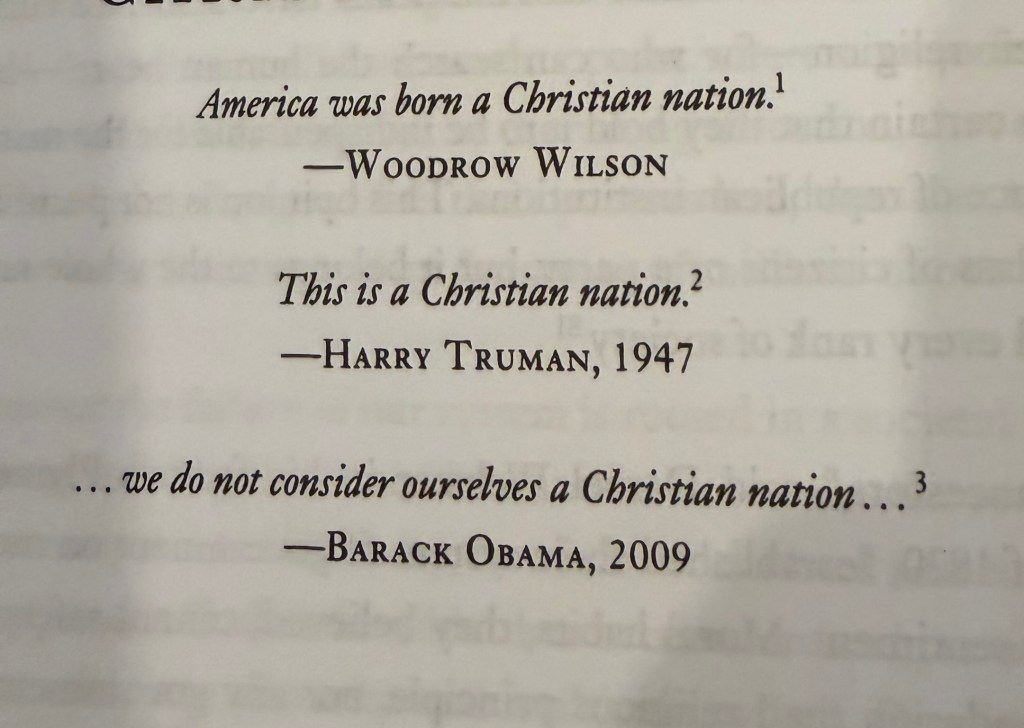
ADDENDUM: Were Wilson and Truman probably referring to the “social gospel,” or a fairly progressive version of Christian faith?
Yes, probably so. But the point is that into the middle of the 20th century, the influence of and the centrality of the Christian faith (in some form) to American history and identity was still widely acknowledged.
—
It’s politically incorrect, but the book of Proverbs is honest about women. Proverbs confronts typical female sins such as immodesty, obsessing over male attention, manipulation, gossip, resistance to accountability, and the nagging/disrespectful wife. Proverbs dismantles the “all women are wonderful” myth by showing there are good and bad women (just as there are good and bad men). There are many wonderful women (see for example Proverbs 31), but many women are terrible (see for example Proverbs 7) and should be avoided by the young man. The book of Proverbs is red-pilled. The book of Proverbs does not coddle women, as so much of the modern church has done. Proverbs speaks hard truth to men and women both. It exposes the lies the modern world has told to and about women.
Bottom line: The book of Proverbs is right about women.
ADDENDUM: Note that in Proverbs 31:3, it is King Lemuel’s mother who warns him, “Do not waste your strength on women” — which is to say, do not spend time and energy pursuing women who will destroy you. The mark of a wise woman is a woman who sees how dangerous some women can be. King Lemuel’s mother warned her son about certain women, even as Solomon warned his son about terrible women earlier in the book.
—
I am normally not a big fan of musicals, but the opening chapters of Luke’s gospel are a beautiful musical. Luke alternates between story and song to give his account of Jesus’ birth. And the songs are not mere decoration; they do more than glorify the events of the narrative. They really contain the theological key to everything. They advance the plot even more than the narrative portions. The four songs in Luke 1-2 sum up everything Jesus came to do. They are rooted in Old Testament language and categories from Israel’s past, but they are also prophesying the coming future now that the king is conceived/born. The four songs are like four sung sermons that explain what God is doing, as the promise-making, promise-keeping God.
—
The first Christmas was full of singing. The virgin Mary is told she will conceive the promised Messiah and she sings. John the Baptist is born, and Zacharias sings. The night Jesus was born, the angels sang. When Jesus is brought to the temple, Simeon sings.
Every time God does something new in history, his people break out in new songs. The exodus leads to the song of Moses. Deborah sings after victory over Sisera. Hannah sings after the birth of Samuel. David wrote song after song when God delivered him again and again. A new work of God requires new songs.
Singing and victory go together in the Bible. But the burst of song surrounding Jesus’ birth is unprecedented. For Mary, Zacharias, the angels, and Simeon, their joy over the birth of Christ overflows into song. And so there is no better way to celebrate Jesus’ birth than with singing. Christians are a singing people year round — but especially at this time of year we should be singing our hearts out.
—
Systemic misandry remains an unsolved problem in our society. Society as structured today subtly yet systematically undermines and emasculates men.
Misogyny is often recognized and called out for what it is. Women can say things like “men are trash” with little fear of reprisal. It does work the other way around. Misandry often goes unchecked and unchallenged.
—
What exactly is post-liberalism at this point? It has to more than the claim “liberalism has failed.” For example, what do post-liberal do with the Bill of Rights, particularly the first and second amendments? What do post-liberals do about the suffrage question (if the consent of the governed is even a post-liberal principle)? What do post-liberals believe about free markets and private property?
In a fallen world, anything and everything can and eventually will fail because, well, fallen people are running the system. Even the God-given system of Torah – a perfect law system if there ever was one – eventually failed because the people could not keep it. Whatever post-liberals propose/implement will eventually fail as well. But that does not mean all systems of governance or societal organization are equal. Some are truly better than others. Classical liberalism had a lot to offer; it got a lot right. But it also contained the seeds of its own destruction (something that America’s founder recognized – think of Ben Franklin’s “if you can keep it” line). How can post-liberalism preserve what liberalism got right, and improve upon it? Does post-liberalism require us to “burn the system down” (with the resulting chaos and probably some kind of dictatorship) or can work within the remaining vestiges of liberalism to produce meaningful reform?
—
The Christian faith inverts the victimhood mentality that plagues modern society. Instead of saying “I suffered through X and it made me a permanent victim,” the Christian says, “I suffered through X and it made me stronger and more mature.” For the Christian, trials are not an occasion for whining but for leveling-up. Christian faith produces anti-fragility.
This is what James 1:2-4 teaches. Christians do not turn suffering into perpetual grievance and the victim mindset (which in turn becomes an excuse for one’s own sins); rather, we learn and grow through our trials. Our trials are part of God’s design, aimed at making us stronger and more Christ-like. Suffering is the pathway to glory, not grievance. Christ conquered through being victimized; Christians do the same. This is why, for Christians, even martyrdom is a form of victory. Christians cannot lose because even when we lose everything, we still win.
Christians know they are not justified by their own victimhood; we are justified by faith in Christ – who was a perfectly innocent victim in his crucifixion and was then vindicated and made victorious in his resurrection.
—
The Christian, more truly than Nietzsche, can say “That which does not kill us makes us stronger.” But the Christian can also say, “Even that which kills us makes us stronger.”
—
“The civil war within conservatism will not be resolved by the choice of universalism over nationalism or nationalism over universalism. It will be resolved by an integration of the two: by a vision of America that honors both the dignity of every person and the particular heritage of its people.
The future of our nation depends on whether we can achieve that synthesis. So does the future of conservatism. And if we are willing to learn from the stories of those who have wrestled longest with the tensions of identity and belonging—black Americans and Jewish Americans among them—we may yet find a path that avoids both abstraction and resentment, both moralism and tribalism.
A conservatism that achieves this synthesis will be intellectually coherent, morally serious, and culturally grounded. It will conserve not only the inheritance of the past but the promise of the future.”
— Glenn Loury (https://firstthings.com/tucker-and-the-right/)
This is an interesting article. I think it misses a few key points but it also makes some really good points. Is conservatism about defending a universal ethic (divine law) or defending a particular civilization (Western culture)? Can it be one without the other since Western civilization attained peculiar greatness precisely through its adherence to the absolute norms of Scripture and natural law?
—
If a black conservative is running against a white progressive, who does the rightwing white identitarian vote for?
This is a test of the limits of racial identity politics.
I would vote for the black conservative because conviction and character matter more to me than skin color. It would be better for white to live under black civil leadership implementing conservative policies than a white civil ruler implementing progressive policies.
We can turn it around. If a black conservative runs against a white progressive, who blacks vote for?
It seems to me that racial identitarianism is subordinate to ideology and party politics, almost always. Or to put it another, racial identity politics is used as a tool and weapon to further ideologies that might otherwise not advance with the same effectiveness.
—
Skeletor makes a great point about immigration vs invasion on X:
“Point of order for all the progressive Christians: yes, the Bible does ask us to welcome the stranger.
However, invading armies of Midianites, Edomites, Moabites, and Philistines were violently removed.
There is a difference between lawful immigration and invasion.”
—
“The domestic employments of each of them are also different; it is the man’s business to acquire subsistence, the woman’s to take care of it.”
— Aristotle, Politics, ch 4.
—
The Christian faith is the glue that held Western civilization together. Without it, our civilization falls apart.
A shared religious and moral consensus is necessary to cultural and civilizational coherency.
—
A people who sacrifice the future for the present will have no future. A people who sacrifice the present for the future will own the future.
—
Unassimilated immigrants end up creating a nation within a nation, which creates permanent division and eventual death.
—
“Civilizations die from suicide, not by murder.”
— Arnold Toynbee
—
“He was a baby and a child, so that you may be a perfect human.
He was wrapped in swaddling clothes, so that you may be freed from the snares of death…
He was on earth that you may be in the stars.
He had no other place in the inn, so that you may have many mansions in the heavens.
He, being rich, became poor for your sakes, that through his poverty you might be rich.
Therefore his poverty is our inheritance, and the Lord’s weakness is our virtue.
He chose to lack for himself, that he may abound for all.”
—St Ambrose
—
https://www.bahnsen.com/blog/greg-bahnsen-30-years-remembered
A very fitting tribute to a great man. When he passed, the whole church did as well. I can still remember exactly where I was when I heard he had passed away.
I used to have 100s of Greg Bahnsen cassette tapes – he was my traveling companion in the car almost every day for years. His overview of the history of philosophy was a crucial catalyst for many of my papers while I studied philosophy in graduate school. He was always humble and always preeminently concerned with the peace and purity of the church. I can still remember shaking his hand and speaking to him for a good while after he preached at Chalcedon in Atlanta – probably 1994 or so.
I think David is right that the last 30 years would look a lot different, and a lot better, in the church had God spared him. Alas, our Heavenly Father knows best.
—
WLC 139 asks, “What are the sins forbidden in the seventh commandment?”
The answer includes the “undue delay of marriage.”
Putting off marriage too long (or altogether) is one of the chief ways our culture disregards the seventh commandment.
Freya India talks about delaying marriage:
“If you meet someone too soon, fall for them too fast, that’s when your family worries for you. Parents are judgemental only when it comes to commitment. They worry about their daughter closing down options; they feel she is too young to commit, even when she is the same age they were, sometimes older. Announce you’re getting married in your twenties and complete strangers will rush to tell you horror stories about affairs and divorce and heartbreak. Why would you do that to yourself? Don’t do what I did, throw those years away. We don’t scrutinise the 25-year-old who is still single but the one who settles down.”
—
A lot of what gets called anti-Semitism is not Jew hate. It’s just “noticing” that Israel gets special treatment in the US and that’s not always good for our country.
There are people who hate Jews because they are Jews, which is sinful. But in many cases, the charge of anti-Semitism is being leveled against people who have no particular axe to grind with Jews because they are Jews, but with our policy towards Israel and Israel’s actions towards us.
—
Progressivism (especially LGBTQ progressivism) is a cult and makes people miserable.
—
“The virgin birth is posted on guard at the door of the mystery of Christmas; and none of us must think of hurrying past it. It stands on the threshold of the New Testament, blatantly supernatural, defying our rationalism, informing us that all that follows belongs to the same order as itself and that if we find it offensive there is no point in proceeding further.”
— Donald Macleod
—
For 1500+ years, however imperfectly, Christian sexual morality informed Western civilization and made it incredibly prosperous. Sexual chastity and lifelong monogamous marriage were the norm for centuries. The Boomers destroyed it in one generation.
—
I feel truly sorry for the generations that come at the tail end of Western civilization. They will not only have the pain of living in a dying world order; they will agonize over what was but has now been lost. They will grieve over an inheritance that was squandered before they could receive it.
—
For 1500+ years Christian sexual morality informed Western civilization and made it incredibly prosperous. The Boomers ruined it in one generation.
—
Jesus kept the law perfectly. That does not make the Christian’s imperfect law-keeping unnecessary.
The gospel is not antinomian. Rather, it produces a law-fulfilling people.
—
The kind of inheritance taxes socialists propose are a way of breaking apart the generations, undermining the family, and cutting us off from our past.
—
We should stop talking about “porn addiction” and start calling it what it is — masturbation addiction.
—
Islam is not compatible with Western civilization, it aims to conquer Western civilization.
—
Unsolicited advice is rarely taken. It’s hard to help people who don’t want to be helped.
—
The word for “witchcraft” or “sorcery” in the NT is “pharmakeia” (eg, Galatians 5:20), from which we get words like “pharmacy.” Witchcraft is closely associated not just with spells, incantations, and curses, but with potions, brews, and drugs. The biblical category for the corner drug dealer is “witch” or “sorcerer.” You may not think of him as a witch or warlock but he is.
This does not mean everything we call a drug today is a form of witchcraft – but many drugs are. There are certain drugs that have always been associated with witchcraft – particularly psychedelic and hallucinogenic drugs. These kinds of drugs are not just chemicals; they are gateways to the demonic realm. Their use is a form of witchcraft. These drugs do more than create biochemical changes in a person; they tap into the realm of spiritual darkness. The experience of “getting high” is actually “getting low” – it is a demonic experience. Drug users refer to their experiences as a “trip” – and drug use is a trip, straight into the underworld. If witchcraft didn’t work, if it didn’t actually beckon the demons, the Bible would not speak so harshly against it.
An individual who dabbles with these kinds of drugs is messing with forces he does not and cannot understand or control; he is playing with demonic powers and opening himself up to their influence. These drugs are deeply deceptive – they often bring great experiences of euphoria and pleasure at first, but then things turn dark.
A society that opens itself up to these kinds of drugs is opening hell’s gate. The problem with the American “war on drugs” is that it was not theonomic enough. (It’s weird that some theonomists have taken a rather libertarian view of these drugs; I can only conclude they do not understand the full breadth of what witchcraft entails.) The law of Exodus 22:18, “Thou shalt not suffer a witch to live,” should have been applied to drug dealers long ago. Instead, we’ve played around with the problem and let it grow out of control. This is why the demonic has such a grip on American culture.
Interestingly, in Deuteronomy 18, witchcraft is prohibited in the same breath as child sacrifice. These are pagan practices that should be rejected by Christians and outlawed in Christian nations. And note that in American history, the rise of drug culture, the sexual revolution, and the legalization of abortion (Molech worship) all arise within a very short timeframe in the 1960s and 1970s. These things are always a package deal, and always a part of paganization. We must suppress and criminalize these forms of paganism as part of re-Christianizing our society.
ADDENDUM: Liddell-Scott defines the term as “the use of any kind of drugs, potions, or spells.” That’s broader than what the Bible is condemning, but certainly the Bible does condemn the use of certain drugs and spells in an idolatrous context. The Friberg Lexicon defines the term as “one who prepares or uses drugs for magical purposes or ritual witchcraft.” The Louw-Nilda lexicon as “the use of drugs for any kind of magical effect or sorcercy.”
Ancient pagan religions almost always used drugs of various sorts. This is well-established. In the West, those drugs were eventually outlawed for just that reason — right up to the the US Supreme Court’s decision to outlaw the native American use of peyote in religious rituals. Nations influenced by Christian faith have rightly outlawed the use of certain substances and this is not a form of legalism; it is prudence. Heroin, ayahuasca, LSD, cocaine, marijuana, etc., should all be illegal. Same with drunkenness; alcohol is moderation is perfectly legitmate, but too much alcohol can open us up to demonic influences as well (e.g., Paul in Ephsians 5 contrasts being drunk on spirits vs being filled with the Holy Spirit).
The Bible does not give us a list of forbidden drugs for obvious reasons, but God expects us to figure it out, obviously.
1 Corinthians 10:21 indicates that demons have a “cup” and a “table.” It is possible to use physcialy substances to commune with demons. 2 Corinthians 11:2-3 indicates that (while the Tree of the Knowledge of Good and Edvil was good in itself and would have been given to Adam and Eve in a righteous way had they exercised patient faith), when Eve ate the forbidden tree, she was deceived into committing spiritual adultery with the serpent. Food and other substances can be a means of communion with God or with Satan.
Obviously, everything God made is good. 1 Timothy 4:1ff affirms the goodness of everything God made, but that does not mean have total freedom to use anything in the creation in any way we want. Some things will kill us if ingested. Others will have negative effects on us if used, or if used to excess. Eeverything in creation is good, but not everything is good for human consumption. Snake venom is part of God’s good creation but I do not want it injected into me. The use of certain substances in a certain context, or with certain intentions, can certainly be a form of rebellion, and open us up to deminic influences and experiences.
Commentator Grant Osborne says this about the use of “pharmakeia” in his exegesis of Revelation 9:21:
“φάρμακον (pharmakon, magic) can mean “medicine” or even “poison” in certain contexts but here refers to the use of “magic potions” in religious rites in the Greco-Roman world. It is interesting that John did not use the more general term φαρμακεία (pharmakeia) for “sorcery” or “magic” but rather chose the term that describes the potions used in the rites. John wants to condemn not just the general practice of magic but everything involved in it (i.e., the paraphernalia as well as the rite itself). Magic was a major problem for early Christianity. One of the signs of victory over paganism occurred when the sorcerers of Ephesus burned their magic scrolls in public (Acts 19:19). Paul listed “idolatry and witchcraft” together as “acts of the sinful nature” (Gal. 5:19-20), for most acts of “sorcery” occurred in the atmosphere of idolatrous worship (note again the connection of idolatry and demonic activity). In the Apocalypse, using magic is how Babylon “led the nations astray” (18:23), and all who practice it will be cast into the lake of fire (21:8; cf. 22:15).”
Stephen S. Smalley, in his commentary on Revelation 9:21, says, the term “sorcercies” refers to
a “drug used as a controlling medium, and this is the equivalent of a magic potion (BDAG 1050a).”
In Os Guiness’ book The Dust of Death P. 236ff), he comments on the rise of drug culture in the 1960s:
“A third defining feature of the counterculture is its resort to drugs, particularly the psychedelics to achieve a transcendental consciousness and a true infinity. Within the movement drugs attained an almost sacramental importance. They are virtually the bread and wine of the new community. But for many outside the movement they are a spectral horror, a phobia almost on a par with communism. . . .
Two preliminary qualifications must be made. First, we are concerned with the psychedelics and not the depressants or stimulants. Many in the sixties generation have taken speed, heroin, and opium; others have resorted to nutmeg or airplane glue. These drugs range from the trivial to the terminal, but the [latter] are hardly worthy of attention, and the horror of the [former] are well documented. The psychedelic movement, on the contrary, shows the resort to drugs at its highest and is close to the nerve of the counterculture. . . . “
David Stern on Revelation 9:21:
“Misuse of drugs in connection with the occult, usually translated ‘sorceries,’ ‘witchcraft,’ or ‘magic arts,’ [and] here rendered by this longer phrase in order to focus on the fact that using potions and drugs is an essential part of the word’s meaning – as is clear from the derived English words ‘pharmaceuticals’ and ‘pharmacy.’ The usual renderings suggest to many people a setting so removed from the fabric of their lives that the text does not speak to them. The reason I employ this lengthy expression is that the Jewish New Testament is a product of the 1980’s, when the Western world has seen an explosion of drug abuse, and I want readers to understand that this subject is dealt with in the Bible.
Spiritually speaking, there are four distinct categories of [psychedelic] drug misuse: (1) taking drugs in order to explore spiritual realms, (2) taking drugs in order to engage in ‘sorcery, witchcraft and magic arts’ while under their influence, (3) giving drugs to other people in order to gain control over them, which is another form of ‘sorcery, witchcraft and magic arts,’ and (4) taking drugs for pleasure. The last is a misuse because the drugs in question – besides whatever temporary enjoyment they provide, and apart from their adverse medical and psychological effects – open a person to supernatural or spiritual experiences; but these experiences are almost always demonic and not from God, since the Holy One of Israel reveals Himself through his Word, not through drugs.”I am not saying these commentators have every detail correct, but the lexical and exegetical evidence indicates that in the NT “pharmakeia” is linked to occultic drug use. Sorcery and witchcraft do not require drug use, but the use of certain drugs use can be a part of them.”
ADDENDUM: Bnonn Tennant asked some good questions in response to my X post: “1. Surely ancient and modern use of drugs is *generally* quite different in its intent. 2. Surely many modern illegal drugs do *not* generally (ever?) result in spiritual experiences. 3. Why did God create psychedelic plants? Are they just evil, like baptists think alcohol is?”
My post already answers 2.
As for 1, I’m not so sure intent is all that different, even if it is described differently. Compare to abortion: Those who procure abortions today may not intend to worship Molech, but I have no problem saying that’s what their child sacrifice amounts to. Same with various forms of androgyny, transgenderism, etc. — it’s all a reversion to paganism even if done by modern scientifically minded people.
As for 3, it’s a good question. Everything God is made is good (1 Timothy 4), but not everything is fit for human use/consumption in the same way. It’s possible some of these things came into creation after the fall, along with thorns and thistles. There is no such thing as using ayahuasca in moderation as there is with alcohol. There is a reason pagans often used ayahuasca, peyote, etc., in their rituals.
Further, in certain contexts, many good things God made we can ordinarily consume can become a form of communing or fellowshiping with demons, e.g., 1 Cor. 10:20-21, where there is a demonic cup and table, and partaking in them in pagan rites made one a participant in demons (whatever that means). Pagan/demonic religions have virtually always made use of a variety of substances, especially psychedelic substances, in their rituals; this is especially true of witchcraft. If witchcraft did not tap into the demonic realm, it’s hard to understand why it warranted the death penalty under Torah. If it was just deception or trickery, it would be a sin, but why a capital crime?
In the NT, it would be very odd to use the “pharmakeia” word group to describe occult activity, sorcery, witchcraft, etc., if no substances were used. Obviously, not every form of witchcraft employs substances, but many do, and so “pharmakeia” becomes a fitting catch-all term for this. Virtually all the Lexicons I’ve looked at include this in the defintion:
Liddell-Scott defines the term as “the use of any kind of drugs, potions, or spells.” That’s broader than what the Bible is condemining, but certainly the Bible does condemn the use of certain drugs and spells in an idolatrous context.
The Friberg Lexicon defines the term as “one who prepares or uses drugs for magical purposes or ritual witchcraft.”
The Louw-Nilda lexicon as “the use of drugs for any kind of magical effect or sorcercy.”
Lewis Ungit’s book Return of the Dragon is a challenging read on this. The Journal of Christian Reconstruction did a symposium on Satanism that includes this quotation from a scholar named McCandlish Phillips (whose work I am not familiar with): “There is a direct and mysterious relationship between certain chemical agents and the supernatural. Certain drugs can carry the user into the realm of the demons. By taking these agents into his body, a person opens up avenues into his soul and spirit by which evil spirits may enter and seize a measure of control. He also opens his body, particularly his nerves and muscular system, to demonic interference and to some degree of physical damage.” I can’t fully explain that (Ungit does the best job of anyone I’ve seen), but I do think it makes sense of lot of what we see in ancient paganism, the occult, and the contemporary use of certain types of drugs.
—
You can be effective for the kingdom of God long after you’re dead if you raise faithful children.
—
Jack Lambert is proof football is no longer the game it once was:
Go back and watch any highlight reel from the NFL or college football from 20+ years ago. Most of the hits they show would be illegal today. It’s still a violent game. Players have gotten bigger and faster (though not tougher). It’s good the game is safer. But it has definitely changed.
—
National ideneity such a complex issue.
A lot of what Josh says I agree with, but there are additional layers
Homogeneity is important to national identity and cohesion
The religion part weighs more heavily in the equation than the race part, but the race part is not irrelevant
Obviously shared history, language, etc. matter
Immigrants must assimilate and groups that have a poor record of assimilating, or who come here to scam the welfare system, should not be allowed in
But America was multiracial from the start, with blacks and Amerindians here all along, even as British and Western European whites were predominant and obviously built the nation, politically, culturally, and economically
So analogies with a nation like Japan seem simplistic to me — Japan does not have out history, and the history of a nation matters to its identity
American just has a different (and pretty unique) history compared to other nations
I wonder if there’s enough of an historic Protestant identity to assert today – though that is what we need to do
But I don’t want anyone to confuse the Trump administration with “Christian nationalism”
Electing Trump was better than the alternative but not a solution
Since 1965, and especially in the Biden era, there no question a “great replacement” was going on – aimed at destroying whatever was left of our Christian identity by eliminating our borders
It was all a statist ploy, and nearly impossible to reverse (despite Trump and Homan and Miller trying)
Faithful Christians are not easy to control, unassimilated third worlders are
The Democrats are pro-open borders because they have always wanted a permanent voting bloc — its not love or hospitality that drives them on this issue
Even the Constitution included blacks in representation, albeit partially — we were always multiracial — we were never fully racial homogenous the way, say Japan was — that has to be acknowledged, whatever else we say about America’s historic whiteness
The genius of America is found in the role the church and Christian faith played — it was not whiteness per se but the Reformed faith that built America — that faith built our institutions, shaped our work ethic, and permeated our culture
That’s the key thing
In the past, immigration was controversial (eg, Roman Catholics coming in from Italy and Ireland) but they could be assimilated into our way of life
But for the last few generations, it’s obviously very different – and very deliberate
The left wants a less white nation because they want a less Christian nation
White does not equate with Christian, obviously, but for much of our history that’s who defined our nation – white Christian people
That’s what they want to destroy
Crushing the black family, the middle class, etc., and importing Muslims, Hindus, etc is a way to do that
—
Husbands are to love and lead their wives. It’s not love without leadership or leadership without love. It must be both. For faithful husbands, leadership is a form of love, and love is expressed in and shapes how he leads.
—
“As women go so goes the culture.”
No one says this because it simply isn’t true. Men are, always have been, and always will be, the leaders. Even when men are feminized so that we live in the longhouse/a gynocracy, men are still on charge. Women can only do what men allow or tolerate them doing. Even feminism requires and depends upon the patriarchy to enforce it. In that sense, the patriarchy is unsmashable.
Thisis not to say women have no impact on culture. They have a massive impact, for better or worse. And of course, how much a particular individual influences culture depends on much more than one’s gender. Status, wealth, positions or offices held, etc. will all bear upon an individual’s impact on culture. But here I am speaking in generalized terms about men and women as groups.
—
Fathers, don’t think your job is solely to provide while you leave raising the children to your wife. She might spend more time with the kids, but you are responsible for your household and the children in your household, so you must be alert, attentive, engaged, involved. You must lead. You must teach. You must discipline. You must ensure that your vision for the household is being enacted even when you are not physically present.
—
It takes wisdom, not merely knowledge, to be a good husband and father. Reading books and listening to podcasts is not the same as putting good family leadership into practice. There is no formula or paint by numbers kit. What you read in books and hear on podcasts must still be implemented in your particular household – and that requires not just accumulating knowledge but putting wisdom into action.
—
Submitting to a husband would be easier than the imaginary burdens wives often put on themselves:
It’s often said that submitting to a husband protects a woman from having to submit to other men. But it is also true submitting to a husband can protect a wife from submitting to the ideals in her own head. Many wives who over-function and are over-burdened are not trying to please their husbands but trying to please themselves. Submission to a husband would actually be easier and relive burdens compared to living under the tyranny of their own emotions and ideals.
(Note: there is some language in this clip.)
—
“It is easy to be a madman: it is easy to be a heretic. It is always easy to let the age have its head; the difficult thing is to keep one’s own. It is always easy to be a modernist; as it is easy to be a snob. To have fallen into any of those open traps of error and exaggeration which fashion after fashion and sect after sect set along the historic path of Christendom – that would indeed have been simple. It is always simple to fall; there are an infinity of angles at which one falls, only one at which one stands. To have fallen into any one of the fads from Gnosticism to Christian Science would indeed have been obvious and tame. But to have avoided them all has been one whirling adventure; and in my vision the heavenly chariot flies thundering through the ages, the dull heresies sprawling and prostrate, the wild truth reeling but erect.”
— Chesterton
—
“At least five times, with the Arian and the Albigensian, with the Humanist sceptic, after Voltaire and after Darwin, the Faith has to all appearance gone to the dogs. In each of these five cases it was the dog that died.”
— Chesterton
—
America had a free market before Nixon opened trade with China. When economic nationalists like Pat Buchanan attack “free markets,” what they are really attacking is globalism. The reality is there is not a global free market because nations do not play by the same rules. One thing Trump got right is our asymmetrical relationship with China.
—
If the USA is going to engage in regime change, let’s start with Europe, not Venezuela. Ha!
—
It’s remarkable to note how many Christmas cards have (unwittingly perhaps) strongly political messages in that they proclaim the birth of a king, one whose government will increase without end, etc. Christmas cards, like so many Christmas carols and hymns, are full of political theology.
—
Repost from Josh Howerton on the “Jesus as refugee” trope:
You’re going to see Jesus selectively-edited for political purposes like this a lot in the coming days. Few things to remember…
- Jesus never broke immigration laws
- Jesus did not “immigrate”: He left Nazareth (in the Roman Empire) to go to Egypt (also in the Roman Empire)
- When they traveled, his family legally registered themselves (Luke 2:1-5)
- Jesus commanded obedience to laws (Rom 13:1), and commanded governments to enforce their laws (Romans 13:3-4)
- People like to selectively-edit Jesus to turn him into a mascot for their cause. You can equally say things like…
“Jesus was a part of the majority culture in his region”
“Jesus came from a patriarchal traditional family”
“Jesus was unvaccinated”
“Jesus fed the poor without raising taxes”
“Jesus told people to buy weapons”, etc
Jesus is a Lord, not a mascot.
- Yes, individual Christians ARE commanded to love all people, including immigrants, and that cannot be disregarded. No, the Biblical command to “love the foreigner among you” does not mean it is wrong for a nation to enforce its immigration laws.J
—
“When the gospel is preached… Christ walks among his people. It’s a miracle of Christmas all over again:Christ clothed himself in humanity, spurning the language of angels to speak with the tongues of mortals.”
— Donald McCullough
—
Our sin makes us less than human, less than what God designed us to be. In Jesus, we see what true humanity looks like. Because he is without sin, he is the perfect and ideal human.
—
The gospel means that on the cross, God did to Jesus what he should have done to me because of what my sin did to him. This is our salvation. Trust Jesus alone. He is Savior. He is King.
—
Sin is man putting himself in God’s place. Salvation comes from God putting himself in man’s place.
—
The Advent/Christmas season is a great time to brush up on Christology. Jesus is the eternal Son of God entering our history and humanity. He became one of us to suffer and die for us, then to rise again and reign on our behalf. Jesus was conceived by the Holy Spirit in the womb of the Virgin Mary. He is fully God and fully man, two distinct yet inseparable natures joined in his one person. He is the revelation of true Godhood and true manhood, the glory of God revealed in human flesh. As the incarnation of God, he makes the invisible God visible to us, manifesting all the divine attributes. He came to fulfill the types and shadows of the old covenant as the new Adam and great David’s Greater Son. He is the only Savior and the world’s true King. Merry Christmas!
—
God became man in order to redeem man. Jesus was sinless, yet became a sin offering in order to forgive and restore sinners to the glory God designed us to have.
—
Hebrews 2 teaches the old creation was an angelocracy. The nations were ruled by angelic/demonic mediatorial princes.
The new creation is a Christocracy. The nations are now under the rule of a man, the God-man, King Jesus.
—
The heart of the gospel is penal substitutionary atonement. Sin deserves wrath. If Jesus did not endure that wrath as our substitute, we are still under the curse. Salvation comes through propitiation, and in no other way. J is our Savior – but what does he save us from? Not merely our mistakes or failing to fulfill our potential or low self-esteem. He saves us from the divine wrath we deserve.
But in order for Jesus to bear that wrath, he has to be fully God and fully man – fully God so his sacrifice will be of infinite value, and fully man so his sacrifice can count in our stead. So the incarnation is the heart of the gospel as well. Only one who God and man, two natures in one person, is for to be our Savior.
To put it another way the gospel is the incantation and the cross, Christmas and Good Friday. The gospel is the person and work of Jesus. Or to be more succinct, Jesus himself is the gospel.
—
Pastors, tomorrow is your game day. Hopefully, you’ve put in the spiritual and academic prep to do your job well when you step into the pulpit. Pray that as you lead the saints into the heavenly sanctuary and into liturgical warfare that you will strike a great blow for the kingdom of Jesus against the prince of darkness! In your preaching, attack sin relentlessly. Show Satan no quarter. In your preaching, pile on gospel comfort so your people experience the love of Jesus through your words. The sword of the Spirit has been put into your hands – wield it skillfully! Live up to the calling you have received. Stir up the gifts you’ve been given. Equip and encourage the troops. Blow the trumpet with clarity and certainty. Preach with courage and compassion. Honor the office you hold. You represent Jesus to his bride – carry out your charge faithfully!
—
Women, as the weaker vessel, are always prone to anxiety. But this is especially true when they are surrounded by weak, effeminate men. When women are around weak men, whether at the familial level or the cultural/social level, their anxiety gets ratcheted way up. A woman’s baseline of fear intensifies when she lacks strong and competent patriarchal covering.
If we inquire as to why so many women today have to be medicated for anxiety (even secularists are noting the problem), the corrosive effects of feminism’s war on “traditional masculinity” has to be at the top of the list. There are other factors, such as women stepping out their natural domestic sphere and into the rough and tumble world of politics and the economy. But the reality is that for women to thrive, their femininity needs to complemented by strong, competent masculinity, and our society has a masculinity deficit.
—
It is well established that women tend to be collectivists whereas men tend to be individualists. Women are more agreeable. They want to fit into the wider group. They are more communal and less hierarchical than men. They are naturally more empathetic towards the weak and less meritocratic. They are more easily infected by social contagions. For example, after no-fault divorce became the norm, if one woman in a friend group divorced her husband, several other women in her group would do the same. The marital discontentment spread among women like a virus. The same thing happened with the transgender craze. One junior high girl would decide she was born in the wrong body and within weeks every other girl in her friend group did the same. Fashion trends work the same way. While men are largely immune to such trends, women are easily enslaved to them. Women don’t even like to go to the bathroom alone; en are the opposite.
This is one reason why I tell husbands/fathers it is incredibly important to get your wife into a wider community of women who respect their husbands, who embrace motherhood, and who are raising their children in the way you want your own children raised. You need to carefully notice who your wife’s friends are. Men also face peer pressure and fear of man. But women fear the disapproval of other women even more than men fear the disapproval of other men. Women are even more imitative in behavior than men. This is why women use weapons of psychological warfare on each other, such as shaming, gossip, passive-aggressiveness, and “cancel culture.” Again, men are not immune to these things, but they are female coded forms of behavior.
—
“Modern women defend their office with all the fierceness of domesticity. They fight for desk and typewriter as for hearth and home, and develop a sort of wolfish wifehood on behalf of the invisible head of the firm. That is why they do office work so well; and that is why they ought not to do it.”
— Chesterton, on the misplaced maternal instinct
—
Faith and repentance always go together. It is impossible to have one without the other.
You cannot turn towards Christ in faith without also turning from your sin in repentance.
—
The relationship of Advent to Christmas is that of promise to fulfillment, type to antitype, and shadow to reality.
—
“It is not our part to master all the tides of the world, but to do what is in us for the succour of those years wherein we are set, uprooting the evil in the fields that we know, so that those who live after may have clean earth to till.”
— J.R.R. Tolkien, The Return of the King
—
Last month, I complained new cars have gotten too expensive, largely due to government regulation. This month, Trump answered:
—
In Milo’s recent interview with Tucker Carlson, he challenged (implicitly) Helen Andrew’s “great feminization” thesis, that claims our culture has undergone a feminizing revolution. Milo says culture has not been feminized, but faggotized.
It’s hard to argue with him. We have been faggotized. The whole culture puts off a gay vibe, especially pop culture. Most all of pop culture is a psyop designed to faggotize everyone, especially children.
However, I still think there is something to Andrew’s claims. We have become faggotized because we were first feminized. Feminization produced the kind of soft, effeminate men who are easily faggotized.
By the way, this interview is crass, sad, and disturbing – though it does have some insights. I’m not recommending anyone listen to it. Beckett Cook did a good follow up podcast with Joseph Nicolosi.
—
Separating politics from religion would have been incomprehensible to people in the first century, especially first century Jews, for whom everything was religious. Jesus came preaching a kingdom. He claimed all authority is his before he departed. Those are political claims.
—
Charles Haywood on nostalgia:
“Instead of taking the easy path, that of bathing in nostalgia, in wanting to go back to the past, however, we should remember that wide is the gate and broad is the way that leads to destruction, and choose to instead take the narrow path of struggle and sacrifice, not only in our spiritual lives but in our political lives.
You cannot force primitivism. By definition this means the future will not be like the past, and in a bright, if very different, future — nostalgia will once again be relegated to a niche taste.
At least, that should be our goal. We cannot go back, the way is shut. It is easy to see why nostalgia is attractive, and why many conservatives today fall into its warm embrace.
The past, even in living memory, was so much better than today, on every axis. It seems obvious that if one finds oneself far down the wrong path, beset by terrors, the logical response is to reverse course. But nostalgia enervates, it prevents action, it fosters pacifism that leads to destruction.
There is no return. All that can be done is first destroy our enemies utterly, and then build a new thing, find both the wisdom of the past and the needs and limitations of the present.”
—
Last month, I commented on the Tucker Carlson/Ben Shapiro debate over free markets. Carlson said he would outlaw AI trucks in order to protect the jobs of truck drivers. I asked about the jobs of engineers who developed the AI trucks. What about their jobs? Their families?
A bit more follow up:
My guess is that Tucker overtstated his point. He would not completely outlaw AI trucks but make sure they got phased in so that millions of jobs would not be destroyed overnight.That is sensible enough – though if he put it that way, it loses its punchiness as a sound bite if put that way.
My thought is, all things being equal, engineers have families to feed too and using the force of the state’s sword to keep them from bringing their product to market in order to protect another group of workers is a form of injustice.
The reality is all technological development engages in “creative destruction.” When the trucking industry arose, it put some people out of work. Podcasters put journalists and news readers out of business. Etc. “creative destruction” seems to be a necessary aspect of he creation/dominion mandate.
Obviously, there are sometimes moral concerns about technology and its use. The market cannot be amoral. It needs to operate within a moral framework.
But the truck driver example bugs me – it seems like an example of sinful partiality in public life, the very kind of thing a magistrate is forbidden to show. The reality is the new tech would probably be phased in slowly without government interference simply because of the capital needed to make the switch over to robo-trucks. Government interference in the market in this kind of way always produces unintended consequences, most of them bad.
I’m very sympathetic with some forms of economic nationalism over against globalism since there isn’t a global “free market” despite 1990s rhetoric. But I think Tucker took it too far in that case.
—
A few thoughts on Ron Dodson’s intriguing article at American Reformer, “The Rule of the Incarnate.”
It seems to me the problem in the modern West is not the rule of law, per se, but that what we call the rule of law is often the opposite.
In a certain sense, the rule of law is good and necessary. Israel’s king was to keep his own copy of the law – in that sense, old covenant Israel was a constitutional/theonomic republic. I beleive this can and should serve as a model for nations and rulers today.
But even under the old covenant, the law was not enough; it needed to be supplemented by wisdom. Yes, the king was to obey the law and apply the law. But this was not a paint by numbers kit, as 1 Kings 3 shows. The king also had to rule by wisdom because the law did not cover every conceivable case (by design) and even application of the law requires wisdom. Biblical law is not antithetical to wisdom; it lays the foundation for wisdom, and wisdom arises out of it. The Moasic law in its old covenant form was training wheels, but Christ has not dispensed with the law. Rather, he transformed the law of Moses into his own law, the law of Christ. If we love him, we will keep his commandments. We cannot dispense with the Word of God in the era of maturity; grown ups are under the law, though in a different sense. We cannot substitute the presence of the Spirit for the Bible; the Spirit is bound to the Word and works through the Word. Christ did not destroy the law, but fulfilled it; we are now called to fulfill the law as well, albeit in a different way than Christ himself.
Christ rules through his Word, not apart from it, and civil magistrates should image that. Lex Rex, rightly understood, is true.
But that’s not how “rule of law” functions in the modern West. What we have today is rule by regulation, rule by procedure, and rule by bureaucracy – it’s an attempt to eliminate the need for wisdom and thus stay immature. The bureaucracy is our new priesthood. Mangerialism is the antithesis of the kind of society the Bible aims to create. It is the antithesis of theonomy. Mangerialism cloaks all kinds of injustices. This is why statism is a form of Anti-Christ – it rejects the rule of Christ through his Word and looks for salvation in the rule of man. God’s law leads to wisdom; man’s law does not, and in fact, man’s law makes us fools.
—
Speaking of Dodson, his article “Dikaiosyne Requires Trinity.” is also worth reading.
The argument has often been made the “God is love” requires the Trinity.
But “God is righteous” is also implicitly Trinitarian.
Of course, all of God’s attributes are inescapably Trinitarian, but it’s wonderful to show how that is the case.
Dodson’s article also makes an important point about how the “dik-“ word group functions in Scripture. i addressed this a bit in my essay “From Birmingham With Love.” English is almost too flexible at points – it gives us too many words to chose from at times, with the result that we can linguistically separate things that theologically belong together. The way we distinguish “righteousness” from “justice” is case in point. The conflation nof “righteousness” and “holiness” would be another one.
—
There is much to like about William Buckley. The modern conservative movement could not exist without him (and before you point out that that movement has not conserved much of value, I woukld make the counterpoint that we’d still be worse off without it).
However, he made a huge mistake in purging Pat Buchanan and other paleoconservatives from the movement. We have never recovered from that fracture, and the current “civil war” among conservatives is in many ways a working out of that division.
—
Jesus is the incarnation of God, which means he is the incarnation of all God’s attributes. He is justice incarnate, love incarnate, wisdom incarnate, etc.
—
Nietzsche explains the consequences of crucifying God and refusing to repent – one must beb prepared to be God himself, a weight no man can bear, which is why Nietzsche sounds so unhappy:
“God is dead. God remains dead. And we have killed him. How shall we, murderers of all murderers, console ourselves? That which was the holiest and mightiest of all that the world has yet possessed has bled to death under our knives. Who will wipe this blood off us? With what water could we purify ourselves? What festivals of atonement, what sacred games shall we need to invent? Is not the greatness of this deed too great for us? Must we not ourselves become gods simply to be worthy of it? There has never been a greater deed; and whosoever shall be born after us – for the sake of this deed he shall be part of a higher history than all history hitherto.”
—
Doug Wilson:
“You can count on our politicians to get out there in front of all of this, so that they may insist on the necessary reforms. But never forget that all the things they need to fix are the result of all their previous reforms.”
—
Feminism will destroy civilization unless we stop it.
—
So the Temptations (whatever’s left of them) performed at halftime of the Detroit game. Amazon Prime didn’t show much but I caught a longer clip here:
It’s really striking to compare this performance to what we get from contemporary black artists today. They sounded great. They looked sharp in their suits. They were choreographed. None of the lyrics celebrated misogyny, rape, or drugs. It was a great performance. Just goes to show you how much our culture (including, or maybe especially, black culture) has changed for the worse over the last 50 years. Younger people cannot even comprehend how degraded our culture has become compared to what it once was. The Temptations were obviously not paragons of virtue in their heyday. But there was a basic decency that prevailed in pop culture. Compared to recent Super Bowl halftime shows, the Temptations performance in Detroit was majestic.
—
“Welfare was radicalized and then served as the springboard for the left’s coup, not by mobilizing the poor into a revolutionary vanguard but by abandoning any concern with poverty and instead turning welfare into a machinery for sexual liberation. It succeeded because conservatives were fooled and enlisted to help the cause in the name of helping single mothers.
If your concern for the poor is genuine, you do not promote welfare, because everyone knows that welfare causes and perpetuates poverty. Until the 1990s, “welfare dependency” and welfare reform were top priorities for both the right and the left—including Marxists, who saw it as an insidious tool of capitalism to placate the poor.
What happened to this consensus?
It was feminists who overturned the anti-welfare consensus by shifting the purpose from relieving poverty to promoting women’s empowerment and sexual freedom. This transformed the welfare matriarchy from a necessary evil into a positive good by intentionally glorifying and proliferating single motherhood. If perpetuating poverty was the price of sexual freedom, they were perfectly willing for others to pay that price….
This “empowerment” of single mothers, and especially of female government functionaries, was expanded dramatically as feminist social workers acquired police powers that originated to administer the chaos of welfare communities and single-mother homes: child protection, domestic violence programs, and child support enforcement. These programs elevated the functionaries into plainclothes police and displaced fathers by usurping their roles of protectors and providers for the women and children.
Indeed, fathers became the principal targets of the new police powers and were demoted in status from merely superfluous to villains. They were transformed from protectors of women and children into “batterers” who abused them, and from providers into “deadbeats” who owed them child support and alimony…
Only by squarely confronting sexual ideology on its own terms will the power of the left be broken. Rising to that challenge will require the courage to endure social discomfort.”
— Stephen Baskerville
—
“The rule of law will not survive the legal profession becoming majority female… If the legal profession becomes majority female, I expect … judges will bend the rules for favored groups and enforce them rigorously on disfavored groups, as already occurs to a worrying extent. … The changes will be massive.”
— Helen Andrews
—
An article in Quillette asserts the following about differences between men and women in the academy:
“The overall theme of these differences is that men are more committed than women to the pursuit of truth as the raison d’être of science, while women are more committed to various moral goals, such as equity, inclusion, and the protection of vulnerable groups. Consequently, men are more tolerant of controversial and potentially offensive scientific findings being pursued, disseminated, and discussed, and women are more willing to obstruct or suppress science perceived to be potentially harmful or offensive. Put more simply, men are relatively more interested in advancing what is empirically correct, and women are relatively more interested in advancing what is morally desirable.”
The problem with this is that the goals women seek are actually all too often immoral, rather than moral. Putting truth against morality is problematic on every level. Disregarding the truth is immoral – and that’s what women tend to do in an academic context, as the data shows. They sacrifice truth on the altar of woke ideology. The only possible conclusion to draw is that the large scale presence of women in the academy destroys the academy, replacing empirical science with leftwing ideology.
Instead the Quillette authors draw the opposite conclusion because they simply cannot bring themselves to admit the corrosive consequences of feminism:
“The point here is not to lament or celebrate these changes, but simply to identify and try to understand them, and to note that they will lead to predictable downstream consequences. Institutions are not independent of the people who populate them, and altering the characteristics of those people will inevitably change them. Those who believe that the purpose—the lodestar—of science should be the pursuit of truth might find these trends worrisome. But it would be unethical and futile to attempt to roll back the enormous social gains women have made. The ‘men’s club’ era of academia is over. A new and more female-oriented era is here for the foreseeable future.”
See: https://quillette.com/2022/10/08/sex-and-the-academy/
—
We cannot save our civilization without bringing back sex discrimination. Feminism must be smashed.
—
White American males find themselves in the rather unprecedented position of being discriminated against in their own country, a country they built from the ground up.
—
Expecting immigrants to assimilate is not racist. It is a good and necessary policy. Those who cannot reasonably be expected to assimilate should not be allowed to immigrate.
—
“Immigration without assimilation is invasion.”
— Pat Buchanan
—
“The heroic feminine prioritizes motherhood and wifeliness and celebrates the men who make it possible.”
— Scott Yenor
—
A writer is someone for whom writing is unusually difficult.
—
A recycled post on paedobaptism:
Paedobaptism is simply grace restoring nature in the context of the family. Paedobaptism just means our children can grow up Christian. God’s new humanity/new creation includes the youngest among us.
Paedobaptism puts a foundation under what most Christian parents want to do instinctively, namely, raise their children as Christians (eg, praying with them, celebrating Christian holidays and seasons with them, singing “Jesus Loves Me” with them, etc.).
Paedobaptism means our children do not need a hurricane-like, dramatic conversion experience when they are older. Rather, they can grow up in a Spiritual rain forest where the covenantal humidity is always very high, so they are continually drenched and soaked in the promises of the Word. They grow up as members of God’s new Israel. The covenant paradigm means our children are not weeds, needing to be uprooted and changed into fruitful plants. The covenant paradigm means God has already claimed them as his own from their earliest days so the parental task is watering, fertilizing, and nurturing the plants God has given us.
Covenant parenting means our children’s testimony does not need a sharply contrasted before and after. They can have a testimony like David’s in Psalm 22. If you asked David when he became believer, he would answer, “in the womb.”
Paedobaptism means our kids don’t need to struggle through an identity crisis, wondering, “Who am I?” That question was answered in their earliest days, when God brought them into his family through baptism. Our children need to be taught to remember who they are, that is, to remember their baptisms. They need to remember that they are dead to sin and alive to righteousness, that they are united to Christ. Covenant parenting is largely a matter of teaching them to remember the covenant God made with them in their youth. We “grab them by their baptisms,”’as Phillip Henry put it.
Some might wonder if paedobaptism and covenant parenting will lead to nominalism. That is a real danger and must be guarded against by applying the warnings of the covenant to our children as much as we apply the promises. But it’s also important to note that the Baptist church has not solved the problem of nominalism. I live in the heart of the “Bible belt” and it’s likely that nominal Baptists outnumber nominal paedobaptists here. The answer to the problem of nominalism is not abandoning paedobaptism, but faithfully practicing church discipline.
—
A couple thoughts based on 1819’s podcast with Andrew Isker:
Keller talked a lot about human flourishing but failed to confront the things that undermine human flourishing, eg, feminism, national borders, etc. Instead of emphasizing the goodness of marriage he talked about the “gift of singleness.” Instead of calling on women to embrace the glory of motherhood, he touted a kind of egalitarianism in cultural life. Instead of emphasizing the importance of preserving national identity and culture, he told whites they had no culture and should embrace immigrants. And so on.
Keller = accommodate the left
Dreher = hide from left until things get better
Kirk = confront the left
Keller brought us the woke church, Kirk brought us revival.
—
Freitas provides a really good summation of how we killed the American dream. Good economic info here.
—
The gospel saves. The social gospel does not.
—
Many Christians need to repent of being too nice. Our niceness has been weaponized against us. We cannot build or defend Christendom with niceness.
—
You must be a Christian for yourself but you cannot be a Christian by yourself.
—
“Every high civilization decays by forgetting obvious things.”
— G K Chesterton
—
“If there is no God, there is no purpose.”
— G K Chesterton
—
The algorithm has replaced fathers, pastors, and even friends for all too many people. The algorithm will swallow up everything if we let it.
—
Much of the urban black community has become a third world country in the midst of a first world country.
—
“Some men are Baptists, others Catholics, my father was an Oldsmobile man.”
— Ralphie Parker, with one of my favorite lines from A Christmas Story.
Speaking of the movie A Christmas Story, it’s recent sequel A Christmas Story Christmas is one my new seasonal favorites. It has some crass language but is otherwise family friendly. It’s full of nostalgia for Gen Xers (the setting is 1973) and has many links to the first movie. It’s not just a great story about fatherhood and perseverance, it also has a marriage with a very healthy dynamic – a husband/father with a deep sense of responsibility to not only give his family the perfect Christmas but be their provider, and a wife who is genuinely respectful and helpful to her husband (which you don’t see often in movies these days). While it’s clear Ralph’s success is the end is the fruit of his hardworking, it’s also clear he could not have gotten there without his wife believing in him and supporting him.
—
Mike Warren and Joseph Ton on communism, the gospel, and the power of optimism:
“Whittaker Chambers, the famous defector from Communism, testified to the power of an optimistic view of history among Communists:
‘I resolved to break with the Communist Party at whatever risk to my life or to myself and my family. Yet, so strong is the hold which the insidious evil of Communism secures upon its disciples, that I could still say to someone at that time: ‘I know that I am leaving the winning side for the losing side, but it is better to die on the losing side than to live under Communism.’
Ironically, Communism borrowed its vision of historical victory from Christianity. But like Chambers, many modern Christians have more faith in the power of Satan’s people to triumph in history than God’s people. Chamber’s defeatist thinking immobilized him from building a viable alternative to replace Communism. Modern Christians are immobilized by the same defeatist thinking. They know that God is powerful enough to take a few more people to heaven, but He’s not powerful enough to move in the hearts of enough people to completely transform a nation to serve Him. Living after the break-up of the Soviet Empire, it should be easier for Christians today to see that God can triumph in history, even over such apparently formidable foes as Communism. But Christians are still suffering from having been paralyzed by the sickness of “rapture fever.” After more than a century of believing that Russia would take over the world and start Armageddon, are Christians prepared to offer something workable in Communism’s place? Are we ready to show the world that Jesus is the answer? The practical implications of believing in the defeat of God’s people in history versus believing in victory is well expressed in a speech made by Romanian pastor Josef Ton:
‘Here is what I told [my friend]: “Communism is an experiment that failed. . . . When communism collapses, somebody has to be there to rebuild society! I believe our job as Christian teachers is to train leaders so that they will be ready and capable to rebuild our society on a Christian basis!” To my surprise, here is what my friend said to me: “Josef, you are wrong. Communism will triumph all over the world, because this is the movement of the Antichrist. And when the communists take over the United States, they will have no restraining force left. They will then kill all the Christians. We have only one job to do: alert the world and make ready to die.” A few years later my friend was forced to leave Romania. He came to the U.S. and settled down. Then I was forced into exile, and I moved to the U.S. as well. Since then, my friend has not done anything for Romania. He simply waited for the final triumph of communism and the annihilation of Christianity. On the other hand, when I came here in 1981, I started a training program for Christian leaders in Romania. We translated Christian textbooks, and smuggled them into Romania. With our partners in the organization, The Biblical Education by Extension (BEE), we trained about 1200 people all over Romania. Today, those people who were trained in that underground operation are the leaders in churches, in evangelical denominations, and in key Christian ministries.’”
—
Oliver O’Donovan on Christendom as the outcome and fruit of the church’s mission:
“Yet readiness for martyrdom is not the only form the Church’s mission must take. Since true martyrdom is a powerful force and its resistance to Antichrist effective, the Church must be prepared to welcome the homage of the kings when it is offered to the Lord of the martyrs. The growth of the Church, its enablement to reconstruct civilisational practices and institutions, its effectiveness in communicating the Gospel: these follow from the courage of the martyrs, and the Church honours them when it seizes the opportunities they have made available to it. No honour is paid to martyrs if they are presented as mere dissidents, whose sole glory was to refuse the cultural order that was on offer to them. Martyrdom is, as the word indicates, witness, pointing to an alternative offer. The witness is vindicated when it is carried through in a positive mode, saying yes as well as saying no, encouraging the acts of repentance and change by which the powers offer homage to Christ.”
Michael Goheen comments:
“O’Donovan recognizes that this interpretation of Christendom leads him away from Stanley Hauerwas. While he acknowledges the force of Hauerwas’s critique of Christendom, O’Donovan challenges Hauerwas’s notion that Christians were attempting to further the kingdom by use of political power. The account of the early church was that those who held power became subject to the rule of Christ and used that power in the service of His kingdom. While this harboured danger and temptation, the early church did not see this as a reason to refuse the triumph Christ had won among the nations. It is “this triumph of Christ among the nations [that] Hauerwas is not prepared to see.” While Newbigin is more aware than O’Donovan of the dangers of Christendom on the mission of the church, there are many points of agreement between them.”
Goheen further comments on Newbigin’s view of Christendom in contrast with contemporary critics of Christendom:
“First, Newbigin’s analysis of Christendom is much more ambivalent than that of the authors of Missional Church. The evaluation of the latter is entirely negative while Newbigin sees many positive features in Christendom. He believes that the Christendom settlement was a worthwhile attempt to translate the universal claims of Christ into social and political terms. Through this thousand-year period the gospel permeated many aspects of social, political, moral, personal, and economic life and western culture continues to live on the capital of that period. Undoubtedly it was his missionary experience in a country where the gospel did not have a lengthy history that enabled Newbigin to evaluate the Christendom experiment much more positively.
For the writers of Missional Church, Christendom necessarily distorts and even eclipses the church’s mission. Acceptance of power contradicts the posture to which the church is called. For Newbigin Christendom posed many dangers to the church’s mission, dangers that were unfortunately realized. Nevertheless Christendom provided an opportunity for the church to work out the claims of Christ’s Lordship in its mission.
He believes that faithfulness to the mission of the church demanded that it not refuse responsibility for the public order. Faithfulness to Jesus who was Lord of history and culture required the church to bring politics under the authority of Christ in spite of the dangers and temptations. Part of the history and legacy of Christendom is what Oliver O’Donovan calls the ‘obedience of the rulers’, the fruit of which remains in the West to the present day (O’Donovan 1996:212-216). Missional Church leans toward an interpretation of Christendom that neglects important emphases in Newbigin’s writing.
Second, while Newbigin affirms the importance of the communal witness of the church, he believes that the primary missionary encounter between the church and the world takes place in the callings of individual believers in society. On the one hand, “the most important contribution which the Church can make to a new social order is to be itself a new social order” (1991h:85). On the other hand, the church must “equip its members for active and informed participation in the public life of society in such a way that the Christian faith shapes that participation” (1991h:81); believers are to act as “subversive agents” in a culture shaped by a story that is in tension with the gospel. Christians ought to seek responsible positions of power and leadership to shape the public life of culture (1991h:84). Newbigin does not contrast the individual and communal dimensions of the church’s mission but maintains them with equal emphasis.
The most striking contrast between Newbigin’s missionary ecclesiology and the ecclesiology formulated in The Missional Church is found at this point. Newbigin believes that the primary way in which the church pursues its missional calling in culture is by “continually nourishing and sustaining men and women who will act responsibly as believers in the course of their secular duties as citizens” (1989e:139). Here, in the life of believers in culture, the primary missionary engagement takes place. This insight permeates the rest of his ecclesiology. By contrast, Missional Church does not mention the mission of believers in culture. This remarkable difference between Newbigin and the authors of Missional Church shows up at other points as well. For Newbigin the importance of the mission of the laity demanded ecclesial structures that would equip them for their task. Yet, in an otherwise helpful discussion in Missional Church, there is no mention of ecclesial structures that would prepare the laity for their callings (Guder 1998:221-247). When Newbigin focused his ministry on training leadership in Madras, a constant refrain was how to find ways to enable the laity in their callings. In Missional Church we find an excellent discussion of leadership but, again, no mention of the training of the laity for their callings in public life (Guder 1998:183- 220). What burned brightly in the heart of Newbigin and found expression throughout his missionary ecclesiology is noticeably absent from Missional Church. There, emphasis on the communal dimension of the church’s mission has eclipsed the mission of the laity the place Newbigin believed the primary missionary encounter takes place.”
(Quotations taken from Goheen’s “As the Father Has Sent Me, I Am Sending You”: J. E. Lesslie Newbigin’s Missionary Ecclesiology.)
—
I appreciated this discussion on paedocommunion with Joshua Haymes from a while back.
—
In 1 Samuel 14, the Israelite militia cancels out Saul’s unjust decree that Jonathan must die for violating an arbitrary law he knew nothing about. This is an example of the biblical, covenantal principle of nullification. Nullification is rooted partially in the principle that legitimate government requires the consent of the governed, but especially in the principle that there is a higher law than the law of the state — namely, the law of God. When civil laws conflict with divine law, lesser magistrates and (in some cases) citizens can act to nullify those laws. Nullification is closely related to the doctrine of interposition. A modern application of this which fits very well with 1 Samuel 14 is jury nullification. Juries not only stand in judgment of the facts of the case (did the accused violate the law?), they stand in judgment of the law itself (is this a just or unjust law?).
—
On Islam:
Leitharts “Mirror Christendom” provides interesting on the background to Islam, as does George Grant’s book “The Blood of the Moon.”
How should we deal with the presence of Islam in America today?
We should definitely not be encouraging the building of mosques, like Russell Moore.
Politically, I’d say no more Islamic immigration and no special privileges for Islam (eg, public calls to prayer in American cities). We should deport illegals. We should prosecute the widespread fraud, especially from Somalis who have come here and ripped us off. We need laws that put pressure on assimilation.
We probably also need to do some foreign policy fixes. Why can’t Muslim refugees go to other Islamic countries? Why do they always flee to the (once) Christian West?
We should especially smash Muslim persecutors of Christians in places like Nigeria.
Ecclesiastically, we have to do evangelism, apologetics, and discipleship.
—
What about the modern nation-state of Israel?
Obviously, this is a flash point in the current conservative “civil war.”
It’s true that Jews have been a subversive presence at times, especially undermining Christian influence in the public square.
The modern nation-state Israel does get special privileges that allow them to steer American politicians in a certain direction. We should end this. No more special treatment, especially based on misguided theology (e.g., dispensationalism).
But the lobbying problem is much bigger than Israel, e.g., we have the same problem with Big Pharma. Everyone is trying to buy off American politicians.
We need to rethink our foreign aid to Israel. Why do we give Israel billions every year when they are a socialist, progressive nation? Of course, Trump rightly raised the same questions about NATO countries in Europe – they can afford socialism because we subsidize their defense. None of it really makes sense.
Jewish conspiracy theorists make it sound like Jews are omnipresent and omnipotent. This is an exaggeration. It’s scapegoating. If we have let Jeiwsh influence harm our nation, it’s still our responsibility.
It’s certainly true Jewish scholars spread cultural Marxism in American universities after WW2. But if American intellectuals were dumb enough to fall for it, that’s on us as much as them. Marx already had a foothold on the academic class, as far back as the 1930s, and not all of it was due to Jewish influence.
—
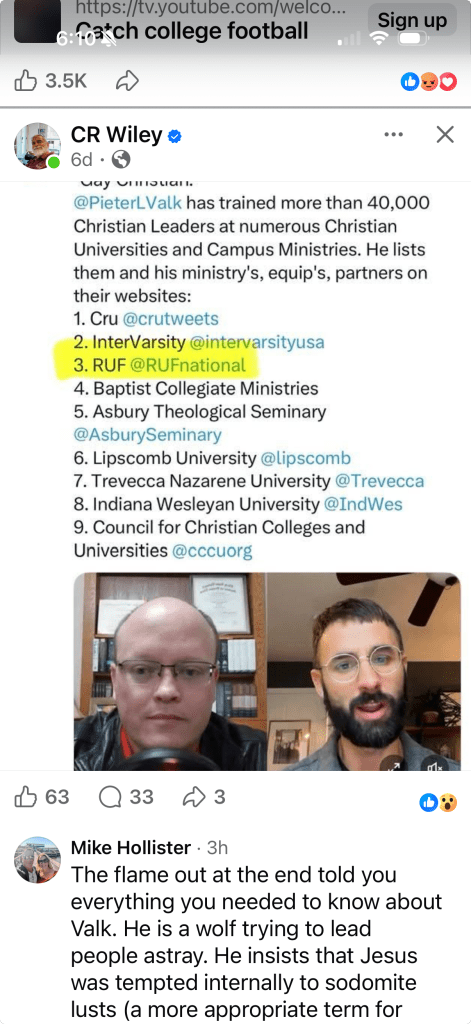
Bebo Elkin, an old school Southern Presbyterian and elder at 1st Presbyterian in Jackson, MS, was once the driving force behind RUF. As far as I could tell, in the 90s most campus pastors were openly conservative because Bebo had a hand in picking them and training them. Bebo was sympathetic with the Recinstructionists/theonomists. He was solid in an old school kind of way.
I had an RUF campus intern give me a copy of Credenda in ‘92 or ‘93, saying, “I think you’ll like this.”
Bebo got driven out and RUF when the PCA reorganized its internal structure, it has never been the same. It became an arm of the Kellerite wing of the PCA, very left leaning, very soft on sex and gender issues, and the comprehensive Christian worldview emphasis has been lost.
 TPC Pastor's Page