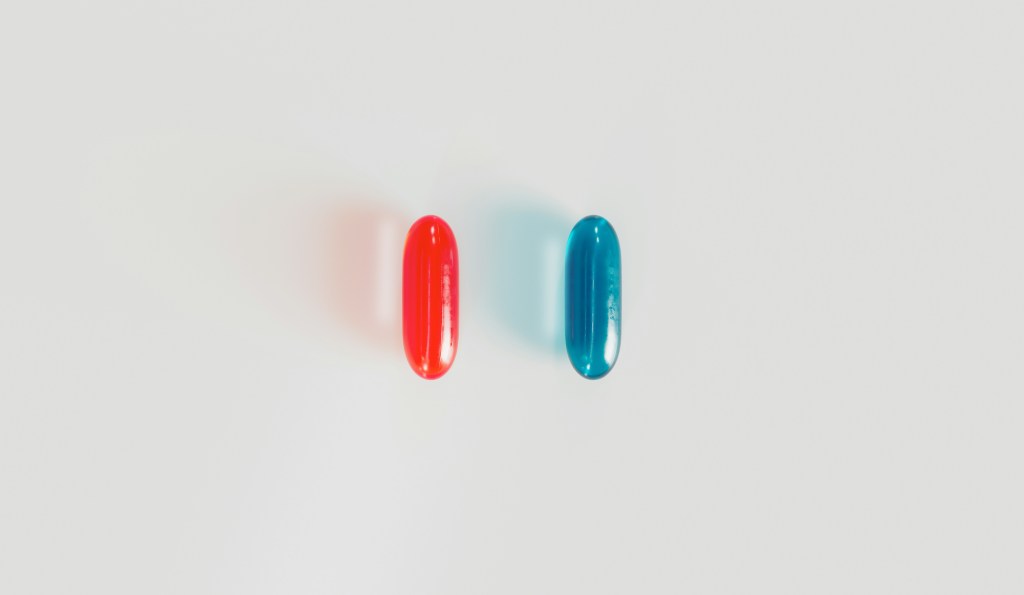
The red pill/blue pill metaphor has gotten mangled to the point that it’s almost useless. I never saw the Matrix movies, but when I first encountered the red pill/blue pill categories, I thought they were fairly helpful interpretive lenses for navigating certain aspects of life in the modern world. I thought the red pill/blue pill approaches to life mapped pretty well onto the biblical categories of the wise man and the fool, and thus could be very useful teaching tools for Christians. While the red pill/blue pill schema has probably gotten most currency in discussions of intersexual dynamics, the basic paradigm is applicable and practical in many areas of life. But, like so many other labels, they have become almost meaningless over time. Here’s my attempt to hit the reset button on how we use these labels to describe two alternative ways of living and make a few applications:
Those who take the blue pill live in a fantasy world, essentially, plugged into the matrix. They ignore the way the world actually works when it does not mesh with their preferences or preconceptions. Their feelings and imagination and ideology define everything for them. Taken to extremes, the blue pill gives us things like transgenderism (the facts of biology are eviscerated by one’s feelings), or socialism (ignoring the laws of economics by promising free stuff from the government), or the #metoo movement (that says gender, rather than evidence and due process, determine guilt and innocence in sex abuse cases), or drug and alcohol abuse (as a way of escaping from the burdens and responsibilities of real life) or women in combat (because we it is foolishly assumed that equality between men and women requires androgyny). Blue pill culture is disastrous because it simply doesn’t work. It doesn’t correspond to reality. But even in milder forms, the blue pill is dangerous because it confuses the way we’d like the world to be with the way it actually is. It ignores the the laws God built into the nature of the world. It is a denial of reality. The author T. S. Eliot said, “humanity can bear very little reality.” That’s the essence of the blue pill.
The red pill, on the other hand, is all about realism. It’s about getting in touch with reality, however difficult or unpleasant. It’s about understanding how the world and life actually work. It is about recognizing that truth sometimes has sharp edges, some aspects of reality are rather unpleasant to face, and wisdom sometimes tells us things we really don’t want to har and wish we could ignore. The red pill forces us to ask: How has God designed us? How is society supposed to function? How is the family supposed to work? How does the human body work and how do I best care for my body? How do relationships work? What do men typically find attractive in women? What do women typically find attractive in men? What do men and women need and want from each other? What kind of marriages make it and what kind don’t, and why? Instead of saying, “Any person of the opposite sex who is good enough for me will have to accept me how I am” (the blue pill way), the red pill says, “I want to be happily married, so I better figure out what it takes to please the opposite sex and then train myself to do those things.” The red pill resists entitlement and scapegoating. The red pill demands an energetic embrace of one’s own responsibility. The red pill means you recognize that most likely you are the source of your biggest problems in life.
The blue pill says, “My feelings define reality.” That’s why those on the blue pill often need safe spaces, trigger warnings, and such. They become emotionally fragile. They are overly sensitive in relationship, constantly getting their feelings hurt even when no real offense has been given. Those who swallow the blue pill think of themselves as victims. They go through life passively; things happen to them and they react (usually in a very emotional way). But they don’t exercise agency in actively changing their lives or the world. By contrast, the red pill way of life says, “Facts don’t care about my feelings. Instead, I must seek to conform my feelings to the facts. Life is full of hardship, but we will struggle and fight through it. We will seek to do God’s will and live according to his design even when it is difficult. Life is brutal but also beautiful.” On the blue pill, life happens to you. On the red pill, you have a plan for life and you seek to actively and wisely build it as much as God in his providence will allow. Obviously, far too many people today are living blue-pilled lives. They are plugged into the matrix. They are not really in touch with reality. A lot of young people have not really come to grips with the way the world actually works, with the way they are designed to live, with what will make them flourish and be happy in the long term. The result is they really don’t know how to manage money, or how to make a relationship with the opposite sex work, or how to have fun without the numbing effects of alcohol and drugs, or how to deal with their emotional problems. A lot of contemporary mental health culture and therapy is very much of the blue pill variety. Therapy can become a way of keeping people on the blue pill, insulated from the hard parts of life. It often comforts and coddles but does not really bring people to maturity; it gives them cliches and platitudes that feel good in the moment, but do not bring lasting change. A wise person will recognize that reality often has rough edges and sometimes the truth is hard to swallow. It can be hard to do what is right and to speak truth, especially if it means changing something about yourself. But it must be done. That’s what it means to live a red pill existence.
 TPC Pastor's Page