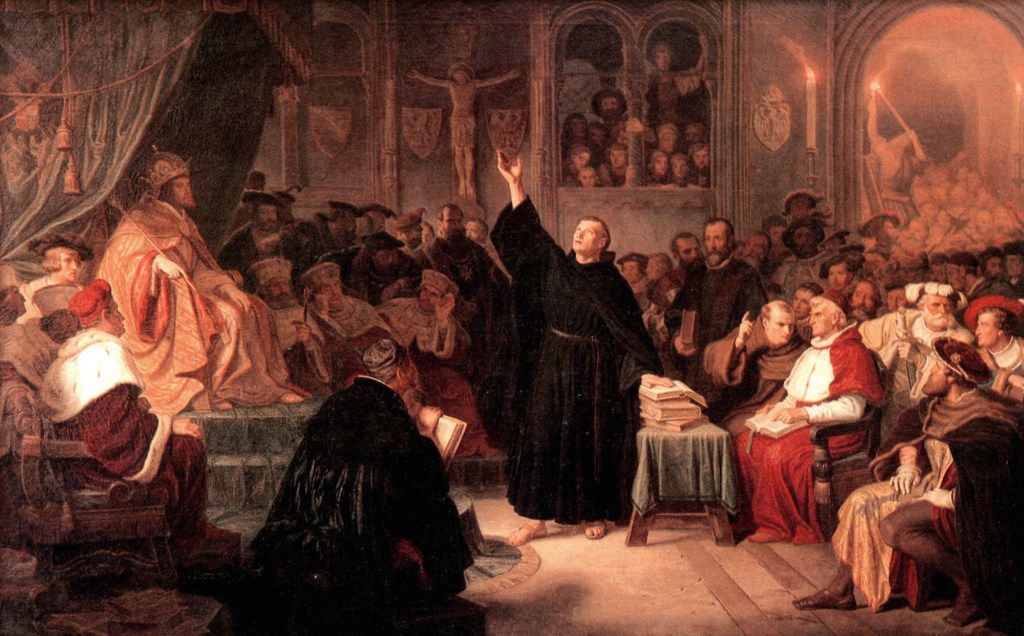
This is an old Reformation Day X post:
A post for Reformation Day:
We often think there are two ways to get the gospel wrong: there are legalists who try to earn God’s favor, and antinomians who presume on God’s favor. Legalists try too hard, antinomians are too lax. Legalists are slaves to the law, antinomians reject it altogether. Legalists do not understand justification by faith, antinomians forget that the final judgment is according to works. This taxonomy is fine, and very useful, pastorally and otherwise.
But it is not the only way of looking at the matter. In another sense, because feelings of guilt are virtually universal, everyone (outside of Christ) is engaged in some kind of self-justification process. This is as true of the legalists, who misuse the law by turning it into a ladder or to heaven, as is it of the antinomians, who silence the law. Both end up substituting their own law for God’s law, tailoring the law to their owns tastes, and at root both are driven by pride and idolatry. We put something in Christ’s place, making something other than Christ our righteousness. But in doing so, we make ourselves equal to God, so all forms of self-justification are really self-idolatry. We must recognize God alone is righteous, and God alone can justify.
Consider how even antinomians practice self-justification through silencing, denying, or redefining God’s law.
Often times, even the most hardened criminal will try to give a justification for what he has done. We are rationalizing creatures, highly skilled at making excuses for ourselves.
Theological antinomians will silence the law in the name of grace. Instead of fulfilling the law by grace, grace abolishes the law. This leads to a religion of pseudo-mercy – mercy without real forgiveness, mercy without sincere repentance. Luther considered antinomians who used the gospel as a license to sin as even worse than the papists. Antinomians end up being just like the legalists in that they seek to establish their own righteousness. They will not accept a law that condemns them; thus, they insist that their sins be approved of, rather than forgiven. The antinomian is actually just as proud of himself as the legalist. Luther was very clear about this, accusing antinomians not only of lawlessness, but also self-righteousness; thus he lumps them in with the legalists. He calls antinomianism “an alien and new way of teaching justification.” But this strategy is no more successful than that of the legalist.
Further, more theologically minded antinomians may end up separating Christ from the Spirit. They presume upon Christ for forgiveness, but separate him from the transformative power of the Holy Spirit. This is the cheap grace Bonhoeffer railed against, and it is a false gospel. A gospel which leaves us in our dehumanizing sin is really no gospel at all. They have, as it has been put, a Christ who ends up justifying sin rather than sinners.
Insofar as antinomianism gets rid of God who is holy and who judges, it is idolatry. Some antinomians admit they sin, but treat sin as too trivial to really matter. Some view God as too distant or uncaring or tame or indulgent to do anything about sin. But this is so far from the biblical view of who God is, it may be considered functional atheism. Antinomians who go so far as to eliminate any kind of sin eliminate Christ as savior. But this leaves self as the only savior.
Self-justification is always a recipe for hypocrisy. It leads to a pretense of righteousness rather than the real thing. Luther called the self-righteous “the devil’s martyrs” because all their showy acts of piety and sacrifice are all for naught in the end, only piling up condemnation and wrath.
Self-justification in any form always leads to a sense of entitlement. Thus, to justify ourselves, we must condemn God. If we declare ourselves holy, then God must be unholy. Either we condemn ourselves so that God can justify us, or we justify ourselves and condemn God. If we are seeking to justify ourselves, every time God allows us to suffer, he has wronged us. God owes us! Any misfortune he sends our way is undeserved. We have a sense of entitlement rather than gratitude. As Michael Lockwood says, “if God’s favor can be bought and we have paid our dues, then God owes us.”
Another form of the same thing: We can assume that because we have suffered so much, there is no way God will let us suffer more in the afterlife. This is “justification by suffering.” But the only suffering that can actually justify us is the suffering of Christ.
Another variation of this dynamic at work is found the modern day obsession with victimization. Victims can claim to be righteous precisely because they are victims. Their victim status automatically makes them righteous.
An excellent discussion of all this and more can be found in Michael Lockwood’s The Unholy Trinity. Lockwood makes a very compelling case that for Luther all forms of self-justification, whether from the right or the left, from the legalist or the antinomian, are acts of idolatry, ultimately because they replace Christ with a false god. Lockwood cites Luther on the various ways we can attempt a false justification: “There is no end or limit to the variety of methods. But they all prescribe heavenward journeys on which the travelers will break their necks.”
Self-justification has all kinds of consequences, many of which Lockwood points out. For example, because programs of self-justification do not really deal with guilt, guilt endures. No idol can cover our sins or take our guilt away. Thus, the fear of judgment, at some deep level, remains. We can deceive ourselves, which the self-righteous certainly do, but only to a point. We know in our heart of hearts we are not righteous and therefore we fear God’s wrath. Our consciences are uneasy, and the guilty man is afraid of a rustling leaf. There is no security in the law – not God’s law, or even our own made substitutes for the law. This is why the gospels tell us the Pharisees – who were just as antinomian as they were legalistic – were only concerned with looking good and gaining approval in the eyes of men. At bottom, their righteousness was really a sham, aimed at self-exaltation in the eyes of others. They pretended to be so secure and confident, as they looked down on others and pretended to be superior, but this was a mask; in the depths of their hearts, they were insecure and anxious.
In the end, Luther says that what drives us the self-righteous to multiply idols is an uneasy conscience, a sense of guilt that will not go away. Luther teaches that “whenever people are without faith in Christ’s justifying work, they will inevitably be driven by guilt to create idols in the false hope they will justify. This involves two basic strategies: self-justification by attempting to keep the law, and self-justification by attempting to silence the law. In practice both strategies end up at the same point: self-justification through tailoring the law to excuse our sins and commend our works. This is a highly unstable enterprise, since it is based on self-deception regarding both the true content of God’s law and our standing before him. It leads to arrogance while this deception holds, but despair when the cracks appear.” (Lockwood).
What are the social and political consequences of self-justification? And of Christ-justification? Rushdoony’s Politics of Guilt and Pity explores this theme quite a bit, but Lockwood’s book does so even more perceptively.
Lockwood also explores the psychological implication of justification for the modern world. He starts with the premise/diagnosis that modern psychology’s obsession with self-esteem is not exactly wrong: “People do have a deep-seated need to be justified, so they can hold their heads high instead of hang them in shame. Luther would disagree with the remedy modern psychologists usually prescribe. He would have no time for the suggestion that we should redouble our efforts to justify ourselves, either by reducing the demands we place on ourselves (i.e., trying to silence the law), or by constantly affirming ourselves and trying to excel (trying to measure up before the law)” (115). Lockwood goes on from there to look at how modern psychology describes the process of self-justification, starting with ways we pass the buck and blame everyone else. You will look in vain for anyone taking responsibility for atrocities like Auschwitz. Everyone involved excuses themselves. Menninger writes, “Every slayer finds reasons for making his particular violation an exception, a non-crime if not a non-sin. Hitler had his reasons…” Again, we are rationalizing creatures rather than rational creatures. We have a self-serving bias built in. If we want to believe we are good people, we can invent reasons to justify that conclusion and to dismiss any contrary evidence. As Lockwood points out, we do exactly what Luther said we do: we fit the law to our works, redefining God’s requirements to match how we have lived. This was certainly the move of the Pharisees, and was a way of keeping their guilt buried deep in their subconscious. Lockwood points out that people often justify their cruelty by convincing themselves their victims deserved it. And, of course, the most powerful justifications are always religious. No one sins more than those who sin in the name of God – but of course in doing so, they call their evil good.
Lockwood shows that we have an innate ability to take credit for our successes and blame others for our failures. In this way, we keep winning the self-justification game in our minds. For example students who get good grades assume they are smart; students who fail tend to blame the exam. This is why most people think they are “above average” – a statistical impossibility. We tend to vastly overrate how good we are, how much we contribute, etc. These self-deceptions allow us to keep passing favorable judgments over our performance so that we can justify ourselves in the end.
Lockwood also explains self-justification in Terror Management Theory. TMT says that virtually all humans operate with the view that they are assured a happy afterlife; otherwise the fear of death would overwhelm us. Self-justification mechanisms become a way of coping with and overcoming the fear of death. This is why idols so easily grip us: we need something to clam our fears and anxieties, above all the fear of death.
Lockwood goes on to explore another basic question: What is humanity’s root problem: too much pride/self-esteem or too low a view of self? He shows that these are not actually not opposites but corollaries. For example, outward manifestations of pride (e.g. the humble-bragging of the Pharisee in Luke 18) actually mask a deeper insecurity. And those who go overboard in self-deprecation are actually taking pride in their show of humility, and thus also acting out of insecurity. Psychologists have actually shown that pride and self-hatred go together; they are part of the same program, often driving us to measure ourselves against an idealized view of ourselves (see p. 118ff for a complete explanation). All attempts at self-justification are neurotic and narcissistic. Self-justification always requires us to create an fantasy version of ourselves, a false and imagined self-image, and then to maintain the illusion that this is the “real me.”
Again the only escape is justification by faith in Christ: only in Christ can we face who we truly are, in the depths of our depravity, and still hold our heads high because of what we are in union with him. The idol of the self wants to establish worth apart from Christ, and thus is an idol put in his place. The gospel tears down this idol so we can face the horrific truth, but assures us of mercy so that the truth about ourselves does not utterly crush us. Lockwood drives this home with the story of a woman who was counseled to use self-esteem boosting methods to fight off her depression (see p. 130). This simply caused her to swing wildly between pride and despair. Only in Christ can we find an answer.
 TPC Pastor's Page