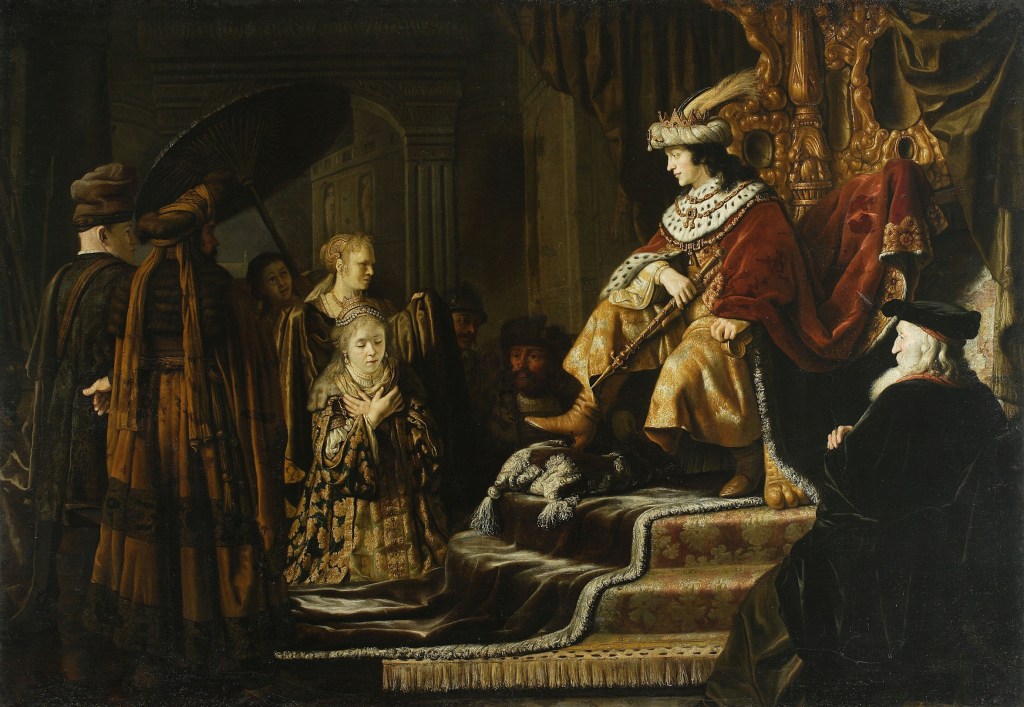
Does the Bible tell us anything about the current war America and Israel are waging with Iran? In particular, can we use the book of Esther to justify or condemn the war?
Tucker Carlson and Franklin Graham recently expressed diametrically opposed views of the Israeli/American war with Iran, making diametrically opposed appeals to the OT, particularly the book of Esther. (See https://open.spotify.com/episode/5FHTWooEkND3m4BrSyBjPs?si=7s5ryv8_TvyCvAxXJvhqaw&t=2840&pi=-IiOuiKRRpG4k for background to this post.)
On the one hand, Franklin Graham was wrong to compare modern Israel’s war with Iran to ancient Israel’s battle with Amalekites in Esther 9. Here is Graham’s prayer:
“Father, you tell us in the book of Esther that the Persians, the Iranians, were wanting to kill every Jew woman, child and do it all in one day but you raised up Esther to save the Jewish people… Today the Iranians, the wicked regime of this government wants to kill every Jew and destroy them with an atomic fire. But you have raised up President Trump. You’ve raised him up for such a time as this and, Father, we pray that you’ll give him victory.”
Modern Israel is not biblical Israel. While there is an ethnic link, the covenantal link between biblical Israel and modern Israel was broken in 70AD when the temple was destroyed and the old Judaic covenant order came to an end. The Jewish people on the whole were broken out of the covenant tree and the kingdom was taken from them in the first century because they rejected the promised Messiah (Romans 11, Matthew 22). Graham was wrong to draw such a tight analogy between what Israel did in Esther 9 and what Israel is doing today. Yes, in both cases Israel is under attack but the circumstances are very different. Just as Graham is wrong to identify the modern nation-state of Israel with old covenant Israel, he is wrong to identify modern Iranians with the enemies of the Jewish people in the book of Esther. It’s not actually the Persians (= Iranians in Graham’s view) who want to kill the Jews in the book of Esther. It’s Haman the Amalekite, who serves in the Persian court. The analogy Graham’s prayer draws is simply not accurate. Overall, the ancient Persians were quite friendly to the Jews for the most part. Not only was Esther the Jew a Persian queen, but we also see Mordecai and Daniel were high ranking officials in the Persian Empire. The Persian king Cyrus issued the decree that led to the rebuilding of the temple in Jerusalem, which had been destroyed by the Babylonians 70 years prior. It’s even entirely possible, if not probable, that the wise men who brought gifts to baby Jesus were Persians, distant descendants of Persian magi who had been discipled by Daniel.
Modern Israel is like any other nation. They can defend themselves according to the standards of just warfare, but they have no special commission from God to destroy their enemies, Persian, Iranian, or otherwise, the way they did the Canaanites and Amalekites in the OT.
Graham also misses what’s happening in Esther. Again, the Persians are not actually the problem in Esther. The problem is Haman, an Amalekite. The Israelites had a long-standing battle with the Amalekites, going back to the exodus, when the Amalekites attacked the weak and the stragglers in Israel. Saul was supposed to utterly destroy them in 1 Samuel 15 but failed to do so; he spared King Agag, and from Agag’s line we eventually get Haman the Agagite in the book of Esther. David fought the Amalekites to rescue his family in 1 Samuel 30 (note that once again the Amalekites had attacked the weak — while David was away from his hometown, the Amalekites attacked his family and the families of his men since they were defenseless). Haman wanted to destroy the Jews and tricked the Persian king into allowing them to be attacked. But that same Persian king, thanks to Esther’s wise intercession, passed a counter-decree allowing the Israelites to defend themselves, which happened in Esther 9. Esther 9 is about legally authorized defensive warfare. It is about the Jewish people engaging in self-defense. The fact that they did not lay hands on the plunder but devoted it to God indicates it was a form of herem warfare (though not identical to the herem warfare waged against the Canaanites to take possession of the promised land). That plunder was probably used to rebuild the temple once the Jews returned to the land a bit later.
On the other hand, Tucker Carlson was wrong in how he interpreted the story of Esther, how he looks at OT holy war, and his suggestion that Jesus is a pacifist.
Carlson virtually throws Esther out of the canon and implicitly criticizes the book for not explicitly mentioning God. But not mentioning God is part of the theological and literary genius of the book. It’s much like the absence of explicit mention of a deity in Tolkien’s Lord of the Rings: The whole point is that God is at work behind the scenes, subtly orchestrating events to accomplish his purposes. God’s hand is invisible but still present. Who raised up Esther for a “time such as this”? The answer is obvious. God in his wise providence takes care of his people, even in unseen ways. God is often most at work when he is most hidden.
In the OT, God does commission Israel to wage holy war (herem warfare) on a couple of occasions, in which they destroy every man, woman, and child of a people group (cf. Deuteronomy 7, the book of Joshua, and 1 Samuel 15). But this is not genocide in any form or fashion. While Israel was commissioned to utterly annihilate the Canaanites, race/ethnicity had nothing do with it. For one thing, God patiently waited until Canaanite wickedness reached it full measure before sending Israel into the land of promise to destroy them (Abraham could not take possession of the land in his day because the evil of the Canaanites had not yet reached its full measure). The conquest of Canaan, like the flood, was a just judgment against an abhorrent people who were wicked beyond what we can imagine. Second, as the case of Rahab shows, Canaanites who repented and changed their allegiance to the true God were spared. Herem warfare distinguishes the guilty deserving of death from the innocent who do not. In herem warfare, God uses his people to administer his own just judgment. In the case of the Canaanites virtually the entire civilization got the death penalty, not because of ethnicity or race but because of idolatry. It was idolater-cide, not genocide.
Carlson, like Graham, misses some key things in the book of Esther. Carlson reverses the direction of the genocide. It is Haman who wants to genocide the Jews; the Jews are not intending to genocide any group. Haman hatches his plot, deceives the king, and assembles an army to exterminate the Jewish people. But the Jews lawfully fight back and kill 75,000 people. These were not innocents; these were people intent on annihilating the Jews and the Jews had every right under God’s law and Persian law to fight back.
But there’s something else worth noticing. Carlson says Jesus never commissioned genocide. Well, of course not. But Jesus is behind the great judgments of the OT. He is the Angel of the Lord who leads Israel to Canaan. The command destroy Canaan comes from him. The eternal Son, the person of the Trinity later incarnated as the man Jesus, is involved in all the judgments of the OT. Jesus is always the judge (cf Acts 17:31).
Jesus sent the flood that wiped out all of humanity except one family.
Jesus destroyed Sodom with fire from heaven.
Jesus killed the firstborn of the Egyptians at the Passover.
Jesus caused the earth to open up and swallow Korah and other revolutionaries in Numbers 16.
Jesus pronounced woes on the Pharisees in Matthew 23 and he struck down Ananias and Sapphira by his Spirit for their deceit in Acts 5. Jesus condemned the temple and city of Jerusalem, declaring not one stone would be left upon another, and in 70AD, he came in judgment on apostate Israel to fulfill his prophecy, using the Romans as his agent of wrath, resulting in over a million deaths (Matthew 24).
Jesus is no pacifist. Jesus is no buttercup. Jesus is both the Lion and Lamb — a tender lamb to those who humbly come to him for salvation, but a fierce lion against the wicked. He administers holy and righteous violence as he sees fit. He is the judge and he executes judgment on the wicked with perfect proportionality to their crimes.
These divine judgments within history, against most of humanity in the flood, against the Canaanites and Amalekites in the ancient world, and against apostate Israel in 70AD, are foreshadowing the final judgment at the last day, when those who have lived in rebellion against Jesus without seeking his forgiveness by faith will be cast into the lake of fire for all eternity. On judgment day, Jesus will wage herem warfare one last time against his enemies. Every Christian knows hell is just because every Christian knows he deserves hell, apart from the redeeming blood of Jesus. Jesus is both Savior and Judge. He bore wrath for those who trust in him as Savior; he executes wrath against those who live in rebellion against him and his wise law. If anyone has a problem with the OT “genocide,” I suggest taking it up with Jesus at judgment day when you met him face to face.
What does any of this have to do with the current war America and Israel are waging against Iran? Not much of anything. There is no more harem warfare in the physical sense. There is no more holy war, only just and unjust wars, waged in just or unjust ways. Harem warfare has been transposed into spiritual warfare (see https://trinity-pres.net/pastor/essays/holywar.pdf).
Whether or not the war with Iran is just, according to historic Christian just war criteria, is a question the Bible does not explicitly answer. Whether or not the war is being prosecuted in a just way is not a question the Bible is going to explicitly answer either. To adjudicate those questions we have to gather the facts on the ground as best we can and then test them against the standards Scripture gives us in texts like Deuteronomy 20. Of course, gathering the facts on the ground is not easy since we live in a propaganda-saturated culture with few trustworthy voices. It’s no surprise good people arrive at varying conclusions about the war since it is difficult to ascertain all the facts.
I have written about the current war elsewhere. My point here is different. My concern, as a Christian and as a pastor, is that biblical narratives not get twisted to either condemn or justify a contemporary war in ways that don’t fit the meaning of the inspired text. Contrary to Graham, what’s happening in Iran today is not analogous to what happened in Esther. The Persians were not the culprits in the Esther story. Haman the Amalekite was the problem, and the Persian king actually provided a legitimate way for the Jews to defend themselves justly. The Persian king unknowingly had chosen a Jewish queen, and she used her leverage with him to provide a way of salvation for her people. She humbly but boldly interceded before the king and revealed her true identity. The whole book of Esther is about reversals. The story ends with Haman justly getting hung on his own gallows, a fitting end to the Amalekite thread in the biblical narrative, while Mordecai the Jew gets promoted to Haman’s former position, to the joy of the people. This divine judgment against the Amalekites in the book of Esther fittingly concludes with the Jews adding a new festival day to their calendar, the Feast of Purim, to commemorate the deliverance. The victory of the Jews even produced something of a revival, as many people converted to the true faith.
But to say that modern Israel is not the same as old covenant Israel and has no justification for waging harem warfare is not to say that the nation of Israel is forbidden from self-defense. I share a lot of Carlson’s misgivings about the current war, but there’s no need to twist the meaning of biblical harem warfare or condemn the book of Esther in order to discredit what Israel is doing today. Carlson, just as much as Graham, is mixed up on who the good guys and bad guys are in the book of Esther. He is is confused about who wanted to commit genocide. He is confused about what the outcome of the story shows us. He is confused about the meaning of herem warfare in the OT. By condemning what God authorized, Carlson is setting himself up as God’s judge and he is exalting his own authority above that of Scripture. He doesn’t intend to do this, but it’s the net effect of his argument.
The deeper problem is that some people who want to criticize Netanyahu and modern Israel don’t stop with the facts at hand; they end up attacking the OT itself in order to bolster their case against Israel. Carlson essentially says, “See, the Jews committed genocide against innocent people in the book of Esther and they’re doing it again against the same people today!” But this is wrong in every way. The Jews did not commit genocide in Esther and the people they fought against were far from innocent — the people 75,000 people the Jews killed in Esther 9 were actually seeking to genocide the Jews out of hatred for them.
Carlson’s anti-war, anti-Israel fervency goes so far that he misses the fact that many Iranians really do want to genocide Israel (and America), and would if they could. That in itself does not justify the war, but it does carry weight. Further, Carlson has become something of an apologist for Islam and Sharia, which no Christian who understands his own faith and understands what Islam is about can do. It is possible to oppose the current war while also opposing the scourge of Islam.
In treating the OT as sub-Christian, Carlson unwittingly ends up subverting the foundation on which the Christian faith rests. I do not believe Carlson is a Jew-hater, but this is exactly how anti-Semites treat the OT. Esther is a canonical book. Esther is Christian Scripture. Esther bears witness to Christ. As a Christian, I, even as a Gentile, have been grafted into the covenant people of Israel, which means it was MY people who were under attack by Haman, and it was MY ancestress in the faith, Esther, who used her position to protect the people of God. I thank God for Esther. I thank God for those Jews who fought back. Apart from their efforts, the people of Israel, and along with them the Messianic line that produced Jesus, would have been exterminated.
I recognize that good people, like Graham and Carlson, can come to very different convictions about the current war. I know people I respect who land on different sides of the current conflict. But insofar as we bring the Bible into the discussion, we need to make sure we use the Bible in a proper way. It is illegitimate to use the story of Esther to prop up a war against Persians/Iranians in today’s world because that’s not remotely what Esther was about. But it’s also wrong to condemn the people of God in the book of Esther for defending themselves when God implicitly authorized it, as a way of bolstering the argument against Israel’s war right now. The book of Esther is Christian Scripture but that doesn’t mean it holds the answer key for a war being waged in 2026. The Scriptures as a whole do give us the guidance we need, but not in the way Graham are Carlson are using them.
 TPC Pastor's Page