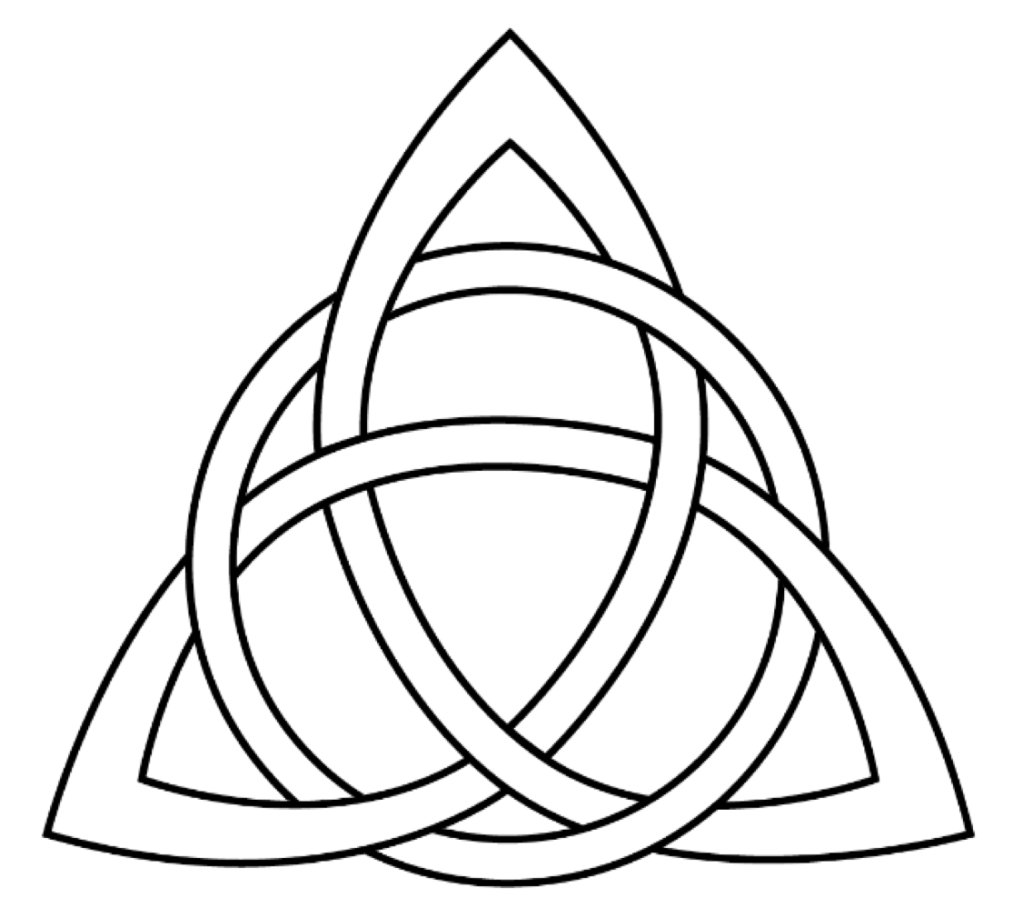
What is the design on the cover of the bulletin?
The design with a circle interlocking a triangular shape is called “triquetra.” The triquetra is a cross between a triangle and a circle. Our triquetra has an additional circle layered into the design.
This perhaps the most widely recognized, traditional Trinitarian symbol. Note that it is an abstract image, not an attempt to “picture” the Trinity in terms of some created object. The three points of the triangular shape point to the co-equality and co-majesty of the three persons of the Godhead. The added circle points to their co-eternality, as Father, Son, and Spirit exist eternally in a “circle” of love, joy, and fellowship.
What is the point of Trinity Sunday?
Trinity Sunday culminates the “special” part of the church year, which tracks the great events of redemptive history (focused on the life of Christ), running from Advent, through Christmas and Epiphany, to Lent, Holy Week, Easter, Ascension, and Pentecost. The calendar tells the Christian story, and the sequence of events clearly unfolds the doctrine of the Trinity. Thus, as a way of capping off this redemptive phase of the church year, we celebrate God’s revelation of himself as the Tri-unity of Father, Son, and Spirit. The rest of year counts “ordinary” Sundays, and may be referred to as the season of Trinity, the season of Pentecost, or the season of the church.
Note that this Sunday includes several deeply Trinitarian hymns, including the classic “Holy, Holy, Holy.” “Holy God We Praise Your Name,” a modernized version of the ancient chant, the Te Deum, is another hymn commonly sung on Trinity Sunday.
Why is our Church named after the Trinity?
The name “Trinity” reflects the centrality of God in our worship and life. The word “Trinity” is simply a synonym for “God” as Christians understand him, because the God revealed in the Lord Jesus Christ is a Tri-unity of Father, Son, and Holy Spirit. In Jesus (and especially in his cross), the life of God is turned inside out so we come to see and know God as he is. The full Godhood of God is most clearly revealed in the humanity of Jesus. There is no “hidden God” lurking behind Jesus; rather, who God is for us in Jesus is a glimpse into who God is in himself.
Thus, Jesus is God’s supreme self-disclosure. But Jesus cannot be understood apart from the Father who sent him, and the Spirit the Father poured out on the church through the Son after his death and resurrection. The church from her earliest days has confessed God is Triune: three eternal persons existing as one being, sharing a life of mutual love and fellowship. The doctrine of the Trinity separates Christian faith from all other religions and philosophies. But it is also the doctrine of the Trinity that unites all of God’s people into one family. We all share a common baptism into the Triune name. We all confess together God’s Triune identity. This is the God we rejoice to worship and serve.
Understanding the Trinity is the key to understanding ourselves. God’s Triune existence is a model for humanity, made in the image of the God who is three-in-one. Because God is a communal being, we know we were made to live in community as well, indwelling one another’s lives as the Father, Son, and Holy Spirit all indwell one another. The Trinity is our pattern: As God is, so the church should be – a holy family, sharing a common life. As God lives, so we should live – in mutual love and fellowship. As God does, so we should do – giving ourselves to one another in love, service, and sacrifice. Our church desires to be a place where the Trinity is not just a doctrine, but a pattern for life (John 17:20-23).
What is the Athanasian Creed?
The Athanasian Creed is one of the great historic statements of orthodoxy, believed by all Christians in all times and places. (This is what the word “catholic” means in the Creed. It is an expression not of this or that group within the church, but of the church’s faith as a whole.) Traditionally, the Creed is recited on Trinity Sunday in churches throughout the world.
The Creed is named for Athanasius, the great defender of the Trinity and the deity of Jesus Christ against Arius and his party in the fourth century A. D. The Creed was probably not actually penned by Athanasius, but summarizes his thought on these biblical truths and reflects his influence. Other likely shapers of the Creed’s content and form include St. Hilary and Vincent of Lerins. The Creed defines these doctrines of the Trinity of the Godhead and the twofold nature of the one divine person of the Lord Jesus Christ as essentials to salvation. The Creed underwent a period of development before reaching it final form, which probably occurred at the Alexandrian Synod of 361, presided over by Athanasius. The condemnations of the Creed are aimed especially at heretics who have been taught the Trinity and Incarnation, and yet still refuse to embrace them. They should not be pressed into those circumstances where they were not intended to apply, such as in the case of new converts or covenant children who have not yet had an opportunity to learn these doctrines in a deep fashion. For liturgical usage, we are using the version of the Creed’s text prepared by the International Consultation on English Texts (ICET) and the English Language Liturgical Consultation (ELLC).
Here is the Athanasian Creed, as we use it in the liturgy:
Pastor: Let us confess our faith together. Christian, what is the one, true, catholic faith?
All: Whoever wants to be saved should above all cling to the catholic faith. Whoever does not guard it whole and inviolable will doubtless perish eternally. Now this is the catholic faith: We worship one God in Trinity and the Trinity in unity, neither confusing the persons nor dividing the divine being.
Pastor: For the Father is one person,
People: the Son is another,
Pastor: and the Spirit is still another.
People: But the deity of the Father, Son, and Holy Spirit is one, equal in glory, coeternal in majesty.
Pastor: What the Father is, the Son is, and so is the Holy Spirit.
People: Uncreated is the Father;
Pastor: uncreated is the Son;
People: uncreated is the Spirit.
Pastor: The Father is infinite;
People: the Son is infinite;
Pastor: the Holy Spirit is infinite.
People: Eternal is the Father;
Pastor: eternal is the Son;
People: eternal is the Spirit:
Pastor: And yet there are not three eternal beings, but one who is eternal;
People: as there are not three uncreated and unlimited beings, but one who is uncreated and unlimited.
Pastor: Almighty is the Father;
People: almighty is the Son;
Pastor: almighty is the Spirit:
People: And yet there are not three almighty beings, but one who is almighty.
Pastor: Thus the Father is God;
People: the Son is God;
Pastor: the Holy Spirit is God:
People: And yet there are not three gods, but one God.
Pastor: Thus the Father is Lord;
People: the Son is Lord;
Pastor: the Holy Spirit is Lord:
People: And yet there are not three lords, but one Lord.
All: As Christian truth compels us to acknowledge each distinct person as God and Lord, so catholic religion forbids us to say that there are three gods or lords.
Pastor: The Father was neither made nor created nor begotten;
People: the Son was neither made nor created,
Pastor: but was alone begotten of the Father;
People: the Spirit was neither made nor created, but is proceeding from the Father and the Son.
Pastor: Thus there is one Father, not three fathers; one Son, not three sons; one Holy Spirit, not three spirits.
People: And in this Trinity, no one is before or after, greater or less than the other; but all three persons are in themselves, coeternal and coequal; and so we must worship the Trinity in unity and the one God in three persons.
Pastor: Whoever wants to be saved should think thus about the Trinity.
All: It is necessary for eternal salvation that one also faithfully believe that our Lord Jesus Christ became flesh. For this is the true faith that we believe and confess: That our Lord Jesus Christ, God’s Son, is both God and man. He is God, begotten before all worlds from the being of the Father, and he is man, born in the world from the being of his mother—existing fully as God, and fully as man with a rational soul and a human body; equal to the Father in divinity, subordinate to the Father in humanity. Although he is God and man, he is not divided, but is one Christ. He is united because God has taken humanity into himself; he does not transform deity into humanity. He is completely one in the unity of his person, without confusing his natures. For as the rational soul and body are one person, so the one Christ is God and man. He suffered death for our salvation. He descended into hell and rose again from the dead. He ascended into heaven and is seated at the right hand of the Father. He will come again to judge the living and the dead. At his coming all people shall rise bodily to give an account of their own deeds. Those who have done good will enter eternal life, those who have done evil will enter eternal fire. This is the catholic faith. One cannot be saved without believing this firmly and faithfully. Amen!
 TPC Pastor's Page